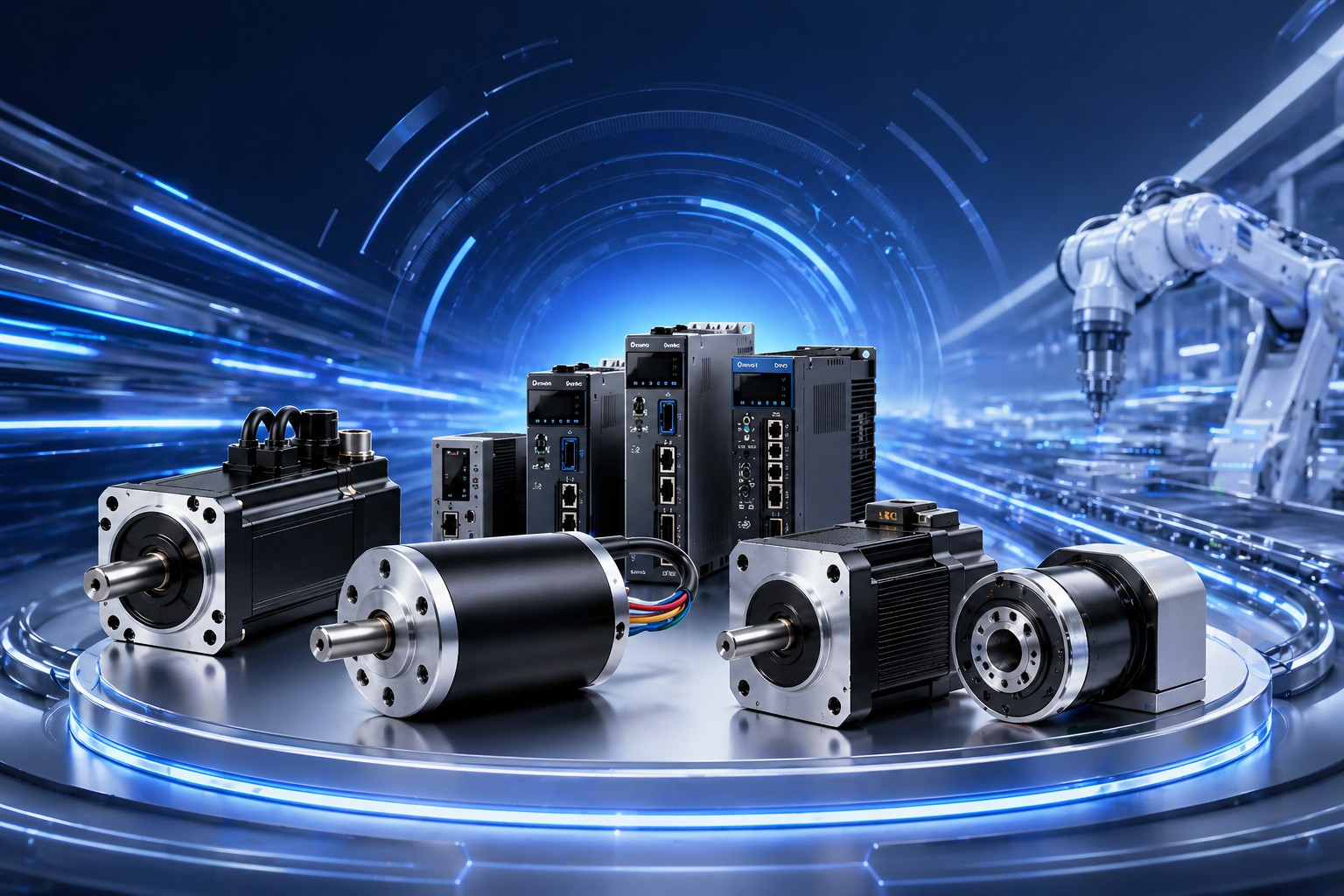
FOC Motor Drive Explained: Understanding Field Oriented Control for Brushless Motors
If you’ve ever wondered why some electric vehicles accelerate with turbine-like smoothness while others feel like they’re shifting through invisible gears, the answer often comes down to one technology: Field Oriented Control. FOC is the control algorithm that separates adequate motor performance from exceptional motor performance.
Table of Contents
- Why FOC Matters
- The Physical Problem FOC Solves
- The Mathematical Foundation
- The Complete FOC Control Loop
- Rotor Position Sensing for FOC
- Field Weakening: Extending the Speed Range
- FOC in Specific Applications
- Common FOC Tuning Parameters
- FOC vs Direct Torque Control (DTC)
- Troubleshooting FOC Systems
- The Future of FOC
- Frequently Asked Questions
Despite being a standard feature in modern motor drives, FOC remains poorly understood by many engineers who specify and integrate these systems. The mathematics looks intimidating, the terminology is confusing (Clarke transform? Park transform? d-q axis?), and the practical benefits aren’t always clear from reading academic papers.
This article demystifies FOC from first principles. No PhD required—just a solid understanding of basic electromagnetism and a willingness to think in rotating reference frames.
Why FOC Matters

Before diving into the theory, let’s establish why you should care about FOC with concrete numbers.
Consider a 1000W BLDC motor running at 3000 RPM. With traditional trapezoidal (six-step) commutation, the torque output fluctuates by approximately 15-25% every electrical cycle. That’s six torque ripple events per revolution. You feel this as vibration, you hear it as acoustic noise, and your mechanical components wear faster because of it.
Now switch to FOC. The same motor at the same speed produces torque that varies by less than 3%. The motor runs quieter, runs cooler (because the current vector is optimally aligned), and delivers more usable torque from the same physical hardware.
Real-world performance differences across common applications:
| Application | Six-Step Commutation | FOC |
|---|---|---|
| E-bike noise level | 65-72 dB | 52-58 dB |
| CNC surface finish | Visible tool marks | Mirror-like finish |
| Motor temperature at rated load | 85-95°C | 65-75°C |
| Energy efficiency at partial load | 70-78% | 85-92% |
| Low-speed torque ripple | 15-25% | 2-5% |
These aren’t marginal improvements—they’re the difference between a motor system that works and one that works exceptionally well.
The Physical Problem FOC Solves
Understanding Torque Production
A permanent magnet BLDC motor produces torque through the interaction between two magnetic fields: the rotor’s permanent magnet field and the stator’s electromagnetic field. Maximum torque occurs when these two fields are perpendicular to each other—just like pushing a door at its edge is more effective than pushing near the hinge.
The stator field is created by currents flowing through three separate windings, spaced 120° apart. These three currents can be thought of as creating a single rotating magnetic field vector. The direction of this vector depends on the relative magnitudes of the three phase currents.
The Challenge with Six-Step Commutation
Traditional six-step commutation drives two of the three phases at any given time, creating a stator field that jumps in 60° increments. The rotor’s permanent magnet field rotates smoothly, but the stator field moves in discrete steps. The angle between them varies continuously—from optimal (90°) to suboptimal and back.
This variation in the field angle directly translates to torque ripple. At the commutation points, there’s often a noticeable torque transient caused by the sudden switching of phase currents. You can minimize this with higher microstepping resolution, but you’re fundamentally working around the problem rather than solving it.
The FOC Solution
FOC takes a fundamentally different approach. Instead of switching between discrete phase combinations, it continuously adjusts all three phase currents simultaneously to maintain the stator field vector at precisely the optimal angle relative to the rotor field.
Think of it this way: six-step commutation is like steering a car by turning the wheel left and right in discrete steps. FOC is like having a steering system that continuously adjusts to maintain the exact heading you want. Both can get you to the same destination, but one is dramatically smoother.
The Mathematical Foundation
The Clarke Transform
The Clarke transform converts the three phase currents (Ia, Ib, Ic) into a two-axis stationary reference frame (Iα, Iβ). Instead of dealing with three variables that always sum to zero, we work with two independent variables.
Mathematically:
– Iα = Ia
– Iβ = (Ia + 2Ib) / √3
This is a simple geometric projection. The three phase currents define a point in a three-dimensional space, but because they sum to zero (there’s no neutral connection in most BLDC motors), the point lies in a two-dimensional plane. The Clarke transform just gives us the coordinates in that plane.
The Park Transform
The Park transform takes the two-axis stationary frame (Iα, Iβ) and rotates it into a reference frame that rotates with the rotor. In this rotating frame, the rotor’s magnetic field appears stationary.
This is the key insight that makes FOC work. In the rotor’s reference frame:
– The magnetic flux from the rotor’s permanent magnets is constant (it’s always pointing in the same direction, which we call the d-axis)
– The torque-producing component is perpendicular to the flux (the q-axis)
– Both components appear as DC values, not AC, even though the motor is spinning
The Park transform requires knowing the rotor’s angular position (θ), which comes from the encoder or Hall sensor:
- Id = Iα·cos(θ) + Iβ·sin(θ)
- Iq = -Iα·sin(θ) + Iβ·cos(θ)
Where:
– Id = flux-producing current (d-axis, aligned with rotor magnets)
– Iq = torque-producing current (q-axis, perpendicular to rotor magnets)
What This Means Practically
After the Clarke and Park transforms, you have two independent, DC-like control variables:
Id controls magnetic flux. In most applications, you drive Id to zero. The rotor already provides all the magnetic flux you need from its permanent magnets. Any flux from the stator just wastes energy (as copper losses in the windings).
Iq controls torque. This is where the action happens. The motor’s torque output is directly proportional to Iq: T = Kt × Iq, where Kt is the torque constant.
By controlling Id and Iq independently through two separate PI controllers, FOC achieves decoupled flux and torque control—something that’s impossible with six-step commutation.
The Complete FOC Control Loop
A modern FOC implementation runs the following sequence at each control cycle (typically 10,000-50,000 times per second):
1. Current Measurement
The drive measures the instantaneous current in at least two of the three motor phases using high-precision shunt resistors or Hall effect current sensors. The third phase current is calculated from Kirchhoff’s law (Ia + Ib + Ic = 0).
Key requirements:
– High sampling resolution (12-bit ADC minimum, 16-bit preferred)
– Sampling synchronized with the PWM carrier (to avoid switching noise contamination)
– Low measurement latency
2. Clarke Transform
The three measured phase currents are converted to the two-axis stationary reference frame (Iα, Iβ).
3. Park Transform
The stationary frame currents are converted to the rotating reference frame (Id, Iq) using the rotor angle from the position sensor.
4. PI Control
Two independent PI (Proportional-Integral) controllers compare the commanded values (Id_ref and Iq_ref) with the actual values:
- Id controller: Typically commands Id_ref = 0. The PI controller adjusts the voltage needed to drive Id to zero, compensating for any back-EMF or cross-coupling effects.
- Iq controller: Commands the torque-producing current. The PI controller adjusts the voltage needed to achieve the desired Iq (and therefore the desired torque).
The PI controllers produce voltage commands: Vd and Vq.
5. Inverse Park Transform
The voltage commands in the rotating frame (Vd, Vq) are converted back to the stationary frame (Vα, Vβ) using the inverse of the Park transform.
6. Space Vector Modulation (SVM)
The stationary frame voltage commands (Vα, Vβ) are converted into three-phase PWM duty cycles using Space Vector Modulation. SVM is more efficient than sinusoidal PWM because it better utilizes the available DC bus voltage—by about 15% compared to simple sinusoidal modulation.
SVM essentially synthesizes any desired voltage vector by rapidly switching between the six active voltage vectors and two zero vectors produced by the three-phase inverter bridge.
7. PWM Generation
The PWM signals drive the six MOSFETs (or IGBTs) in the inverter bridge, producing the three-phase voltages applied to the motor windings.
8. Rotor Position Update
The encoder (or sensorless algorithm) provides the latest rotor position for the next control cycle.
All of this happens in real time, typically within 20-100 microseconds depending on the control frequency. Modern DSPs and dedicated motor control MCUs handle this computational load easily.
Rotor Position Sensing for FOC

Encoder-Based FOC
The most common and most accurate approach uses a rotary encoder mounted on the motor shaft. Incremental encoders with 1000-5000 lines per revolution (giving 4000-20000 counts per revolution after quadrature decoding) are standard for FOC applications.
Higher encoder resolution provides:
– Smoother operation at very low speeds
– More accurate current regulation
– Better positioning capability (in position control mode)
For high-end applications, absolute encoders (multi-turn) retain position information through power cycles, eliminating the need for homing sequences.
Hall Sensor-Based FOC
Standard Hall sensors provide only 6 position values per electrical cycle—far too coarse for accurate FOC. However, sophisticated drives can interpolate between Hall transitions using a combination of:
- Hall sensor edges (coarse position)
- Back-EMF measurement between edges (fine position)
- Motor model-based estimation (prediction during transitions)
This “Hall-FOC” approach delivers many of the benefits of full FOC (smooth torque, good efficiency) without requiring an expensive encoder. The trade-off is reduced low-speed performance and slightly increased torque ripple compared to encoder-based FOC.
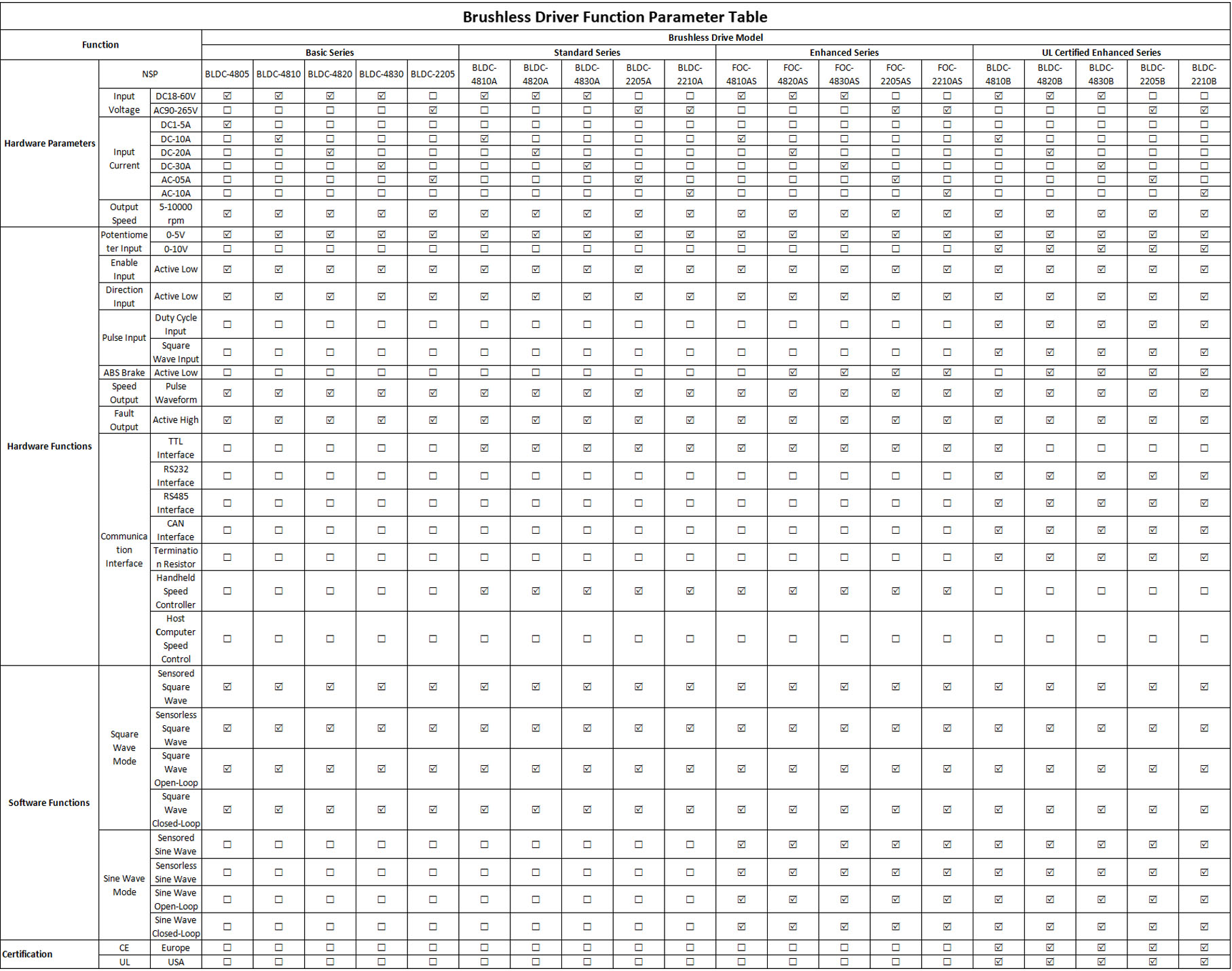
The NSP-FOC4830AS drive supports both Hall sensor and encoder input for FOC operation, making it versatile for a wide range of applications.
Sensorless FOC
Sensorless FOC estimates rotor position using mathematical models of the motor, typically based on:
- Back-EMF observation: At sufficient speed, the back-EMF waveform contains position information. Extended Kalman filters (EKF) or sliding mode observers (SMO) extract this information.
- High-frequency injection (HFI): At low speed (where back-EMF is too small to measure), a high-frequency voltage signal is injected and the resulting current response reveals rotor position through magnetic saliency.
Sensorless FOC eliminates the encoder, reducing cost and connector complexity. But it has limitations:
– Cannot produce torque at zero speed (no back-EMF, and HFI adds losses)
– Position accuracy degrades at very low speeds
– Parameter sensitivity: the motor model must accurately reflect the real motor’s resistance, inductance, and flux linkage
Field Weakening: Extending the Speed Range
Every motor has a characteristic speed at which the back-EMF equals the supply voltage. Above this speed, the drive can no longer push current into the motor—there’s simply no voltage headroom left.
FOC enables field weakening to extend the speed range beyond this natural limit. By introducing a negative Id current (opposing the rotor’s magnetic flux), the effective flux is reduced, which reduces the back-EMF and allows current to flow at higher speeds.
The trade-off is reduced torque capability. As you weaken the field, the available torque decreases proportionally. But you gain speed range. This is analogous to shifting to a higher gear in a car—you sacrifice torque for speed.
Most FOC drives implement field weakening automatically. The drive monitors the voltage headroom (the difference between the DC bus voltage and the back-EMF) and introduces the minimum Id necessary to maintain current control.
Practical example: A 48V BLDC motor with a rated speed of 3000 RPM can typically reach 4000-5000 RPM with field weakening, though torque output above rated speed drops by roughly 1/RPM².
FOC in Specific Applications
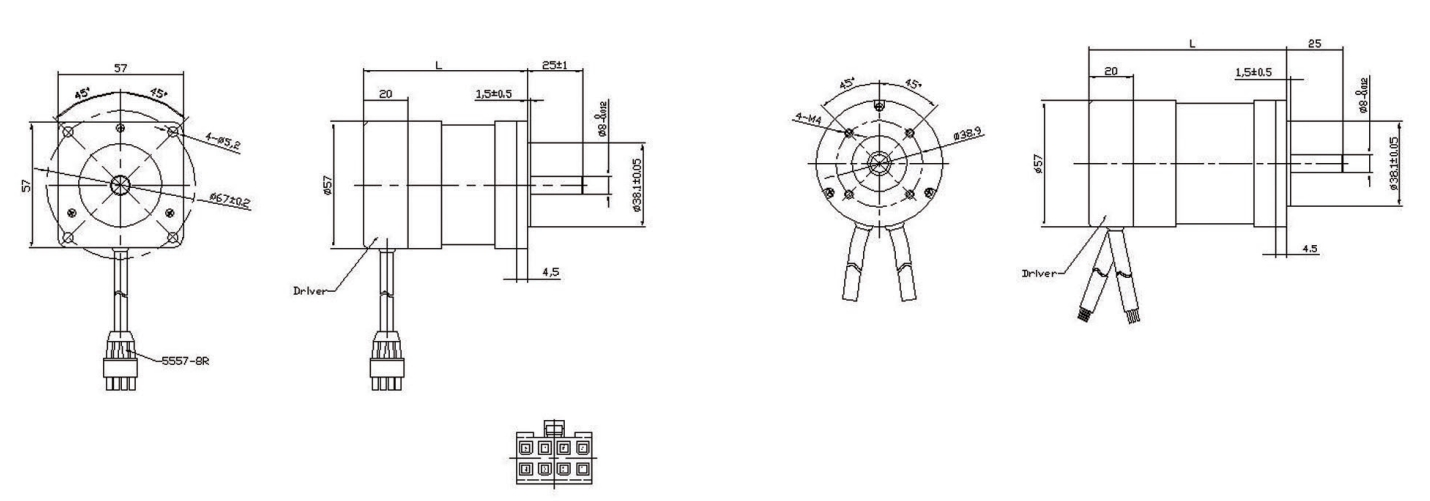
Electric Vehicles and E-Bikes
FOC is the standard for modern EV powertrains and quality e-bike drives. The benefits are tangible:
- Range extension: 10-15% more range from the same battery, thanks to higher efficiency especially at partial throttle
- Smooth acceleration: No jerk or cogging during throttle changes
- Regenerative braking: FOC naturally supports controlled regenerative braking by commanding negative Iq
- Reduced motor noise: Critical for urban vehicles and premium products
Drones and UAVs
Drone ESCs (Electronic Speed Controllers) have historically used simple sensorless commutation due to weight and cost constraints. But professional and industrial drones increasingly use FOC:
- Smoother flight characteristics (less vibration transmitted to the airframe and payload)
- Higher flight efficiency (longer flight times)
- Better motor control at low throttle (critical for precise hovering)
- The computational requirement is met by modern 32-bit ARM microcontrollers at minimal weight cost
Industrial Automation
In factory automation, FOC drives are used for:
- Servo systems: High-performance positioning and speed control
- Conveyor drives: Smooth, efficient continuous operation
- Pump and fan control: Maximum energy savings through optimal flux management
- Winders and unwinders: Precise tension control through torque regulation
HVAC Compressors
Variable-speed compressors for air conditioning and refrigeration are one of the largest applications for FOC technology. The efficiency gains from FOC (compared to simple V/f control) directly translate to lower energy bills for building owners.
Common FOC Tuning Parameters
Even though FOC drives are largely self-configuring, understanding the key tuning parameters helps you optimize performance for your specific application:
Current Loop Bandwidth
The current loop bandwidth determines how quickly the drive can respond to changes in the commanded current. Higher bandwidth means faster torque response but also higher sensitivity to noise and parameter errors.
Typical values:
– 500-1000 Hz for general-purpose applications
– 1000-3000 Hz for high-dynamic applications (servo, robotics)
– 200-500 Hz for high-inductance motors (large frame sizes)
Speed Loop Bandwidth
In speed control mode, the speed loop generates the Iq command based on the speed error. The speed loop bandwidth is typically 5-10× lower than the current loop bandwidth (a rule of thumb based on the need for the inner loop to be significantly faster than the outer loop).
Flux Weakening Parameters
- Id reference at rated speed: Typically 0A (no field weakening needed)
- Field weakening start voltage: The voltage headroom threshold at which field weakening begins (typically 90-95% of DC bus voltage)
- Maximum Id: The maximum negative Id the drive will apply (limited by motor and drive thermal ratings)
Dead Time Compensation
MOSFET bridge dead time (the delay between turning off one switch and turning on the complementary switch) causes voltage distortion at low modulation depths. Dead time compensation algorithms measure or estimate this distortion and pre-compensate the voltage commands. This is particularly important for low-speed smoothness.
FOC vs Direct Torque Control (DTC)
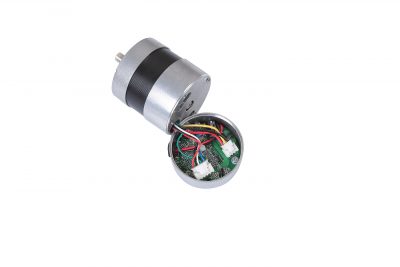
DTC is an alternative to FOC that directly controls torque and flux without the intermediate step of current regulation. Instead of using PI controllers and PWM, DTC selects the optimal voltage vector from a lookup table based on the torque and flux errors.
| Feature | FOC | DTC |
|---|---|---|
| Control variables | Id, Iq (current) | Torque, Flux directly |
| Modulation | PWM (constant frequency) | Hysteresis (variable frequency) |
| Torque response | 1-2 control cycles | Near-instantaneous |
| Current ripple | Low and predictable | Higher and variable |
| Acoustic noise | Lower | Higher (variable switching) |
| Parameter sensitivity | Moderate | Higher |
| Low-speed performance | Excellent | Challenging |
| Implementation complexity | High | Moderate |
FOC is generally preferred for applications requiring smooth operation and low noise. DTC can be advantageous where maximum torque response is critical and acoustic noise is less of a concern.
Troubleshooting FOC Systems
Motor Vibrates or Produces Excessive Noise
Check:
– Motor parameter settings (resistance, inductance, flux linkage) – incorrect parameters cause poor current regulation
– Encoder alignment – the electrical angle offset must be calibrated correctly
– Current loop bandwidth – too high can cause instability, too low causes sluggish response and torque ripple
– Dead time compensation – incorrect dead time settings cause voltage distortion
Inability to Start or Low Starting Torque
Check:
– Initial rotor position detection – sensorless FOC requires a valid starting algorithm
– Encoder index signal – if the drive uses absolute position, verify the index pulse alignment
– Current limit setting – may be set too low for starting torque requirements
– Motor pole count setting – incorrect pole count makes the drive commutate at the wrong electrical frequency
Motor Overheating
Check:
– Id reference – should be 0 or near-zero (unless field weakening is active). Non-zero Id wastes energy.
– Current measurement calibration – inaccurate current sensing causes the drive to push more current than intended
– PWM frequency – higher PWM frequency increases switching losses in the drive, contributing to thermal problems
– Operating point – is the motor oversized or undersized for the application?
Speed Instability or Oscillation
Check:
– Speed loop tuning – reduce proportional gain or increase integral time
– Load inertia – if load inertia varies significantly, consider adaptive tuning or gain scheduling
– Speed feedback resolution – low encoder resolution causes speed quantization, especially at low speeds
– Anti-windup settings – integral windup in the speed PI controller can cause overshoot and oscillation
The Future of FOC
Several developments are pushing FOC technology forward:
Model Predictive Control (MPC): Instead of PI controllers, MPC evaluates multiple possible voltage vectors and selects the one that minimizes a cost function over a prediction horizon. This can provide better dynamic performance than traditional FOC, at the cost of higher computational requirements.
Wide Bandgap Semiconductors: SiC and GaN MOSFETs enable higher switching frequencies (100 kHz+) with lower losses. This improves FOC performance by reducing current ripple and enabling faster control loops.
Integrated FOC Solutions: Single-chip FOC solutions that combine the MCU, gate drivers, and current sensing in one package are reducing board space and design complexity for applications like drones, power tools, and small appliances.
AI-Assisted Auto-Tuning: Machine learning algorithms that automatically identify motor parameters and tune control loops based on measured system response. This dramatically reduces commissioning time and can adapt to parameter changes over the motor’s lifetime.
Frequently Asked Questions
Can FOC work with any BLDC motor?
Yes, FOC can drive any three-phase permanent magnet synchronous motor (which is what “BLDC” motors actually are). However, FOC requires accurate knowledge of the motor’s electrical parameters (resistance, inductance, back-EMF constant) and rotor position. Some motors are easier to work with than others—motors with sinusoidal back-EMF are ideal, while motors with trapezoidal back-EMF can still be driven with FOC but may produce slightly more torque ripple.
Is FOC worth the extra cost for simple applications?
For a fan or a simple conveyor that just needs to run at constant speed, six-step commutation or even simple V/f control is probably adequate and more cost-effective. FOC becomes worthwhile when you need smooth torque, high efficiency at partial load, precise speed control, or regenerative braking.
What’s the minimum MCU processing power needed for FOC?
A basic FOC implementation (current loop only) requires roughly 50-100 MIPS and a hardware PWM module with dead time insertion. A 32-bit ARM Cortex-M4 running at 100 MHz is more than sufficient. Full-featured FOC with sensorless algorithms and field weakening may benefit from a DSP or a Cortex-M7 at 200+ MHz.
Can I implement FOC myself on a microcontroller?
Yes, and many engineers do. ST, TI, Infineon, and NXP all provide application notes, SDKs, and reference designs for FOC implementation on their MCUs. The MathWorks Motor Control Blockset for MATLAB/Simulink also supports automatic code generation for FOC algorithms. However, a production-quality FOC implementation requires significant engineering effort—the drive is safety-critical and must handle fault conditions gracefully.
Does FOC work with stepper motors?
Yes! FOC applied to stepper motors is sometimes called “stepper servo” technology. By driving stepper motors with sinusoidal currents (instead of square waves), you get smoother operation, less vibration, lower acoustic noise, and higher efficiency. This is essentially what closed-loop stepper drives do.
How does FOC handle overload conditions?
The current loop limits the motor current to the drive’s rated value. During an overload (when the load torque exceeds the motor’s rated torque), the drive maintains maximum current but the motor can’t maintain the commanded speed—a following error develops. If the speed error exceeds a configurable threshold, the drive generates a fault. Most FOC drives also monitor thermal conditions and will derate the current limit or shut down if temperatures exceed safe levels.
Related OEM guide: If you want to reduce wiring and package the drive electronics closer to the motor, see our integrated BLDC motor with driver selection guide.
Need Help Selecting the Right Motor?
ZGC Motors offers a complete range of BLDC motors, servo motors, stepper motors, and motor controllers for industrial, automotive, and outdoor power applications. Our engineering team can help you find the perfect solution for your project.