Closed Loop Stepper Motors: The Technology That Changed Precision Motion
There’s a quiet revolution happening in motion control. Not the flashy kind—no dramatic press releases or industry-bending announcements. Instead, thousands of engineers are quietly replacing traditional open-loop stepper systems with closed-loop steppers, and the results speak for themselves: fewer missed steps, lower energy consumption, and machine reliability that was previously only achievable with servo systems.
Table of Contents
- The Fundamental Problem with Open-Loop Steppers
- How Closed-Loop Stepper Technology Works
- Performance Characteristics
- Comparing Closed-Loop Steppers to Alternatives
- Applications Where Closed-Loop Steppers Excel
- What to Look for When Selecting a Closed-Loop Stepper
- Installation and Commissioning Tips
- Limitations and When Not to Use Closed-Loop Steppers
- The Market Landscape
- Frequently Asked Questions
I first encountered closed-loop stepper technology about eight years ago on a pharmaceutical packaging line that was losing thousands of dollars per shift to occasional step losses. The open-loop stepper system worked perfectly 99% of the time—but that 1% failure rate was devastating. Swapping to closed-loop steppers eliminated the problem entirely, without the cost and complexity of a full servo upgrade.
This article covers everything you need to know about closed-loop stepper technology: how it works, what problems it solves, where it falls short, and how to decide if it’s right for your application.
The Fundamental Problem with Open-Loop Steppers
To understand why closed-loop steppers exist, you need to appreciate the core limitation they solve.
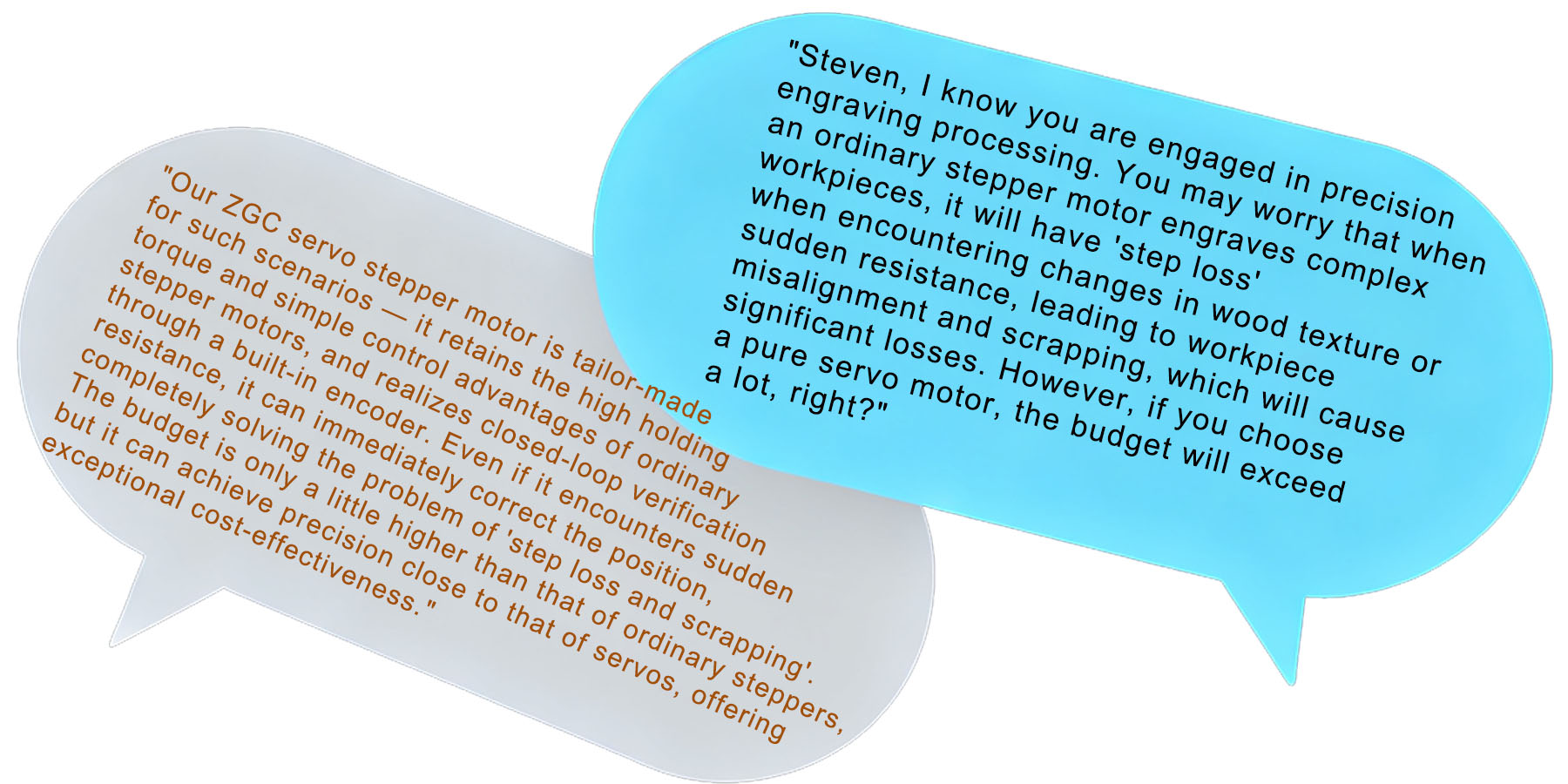
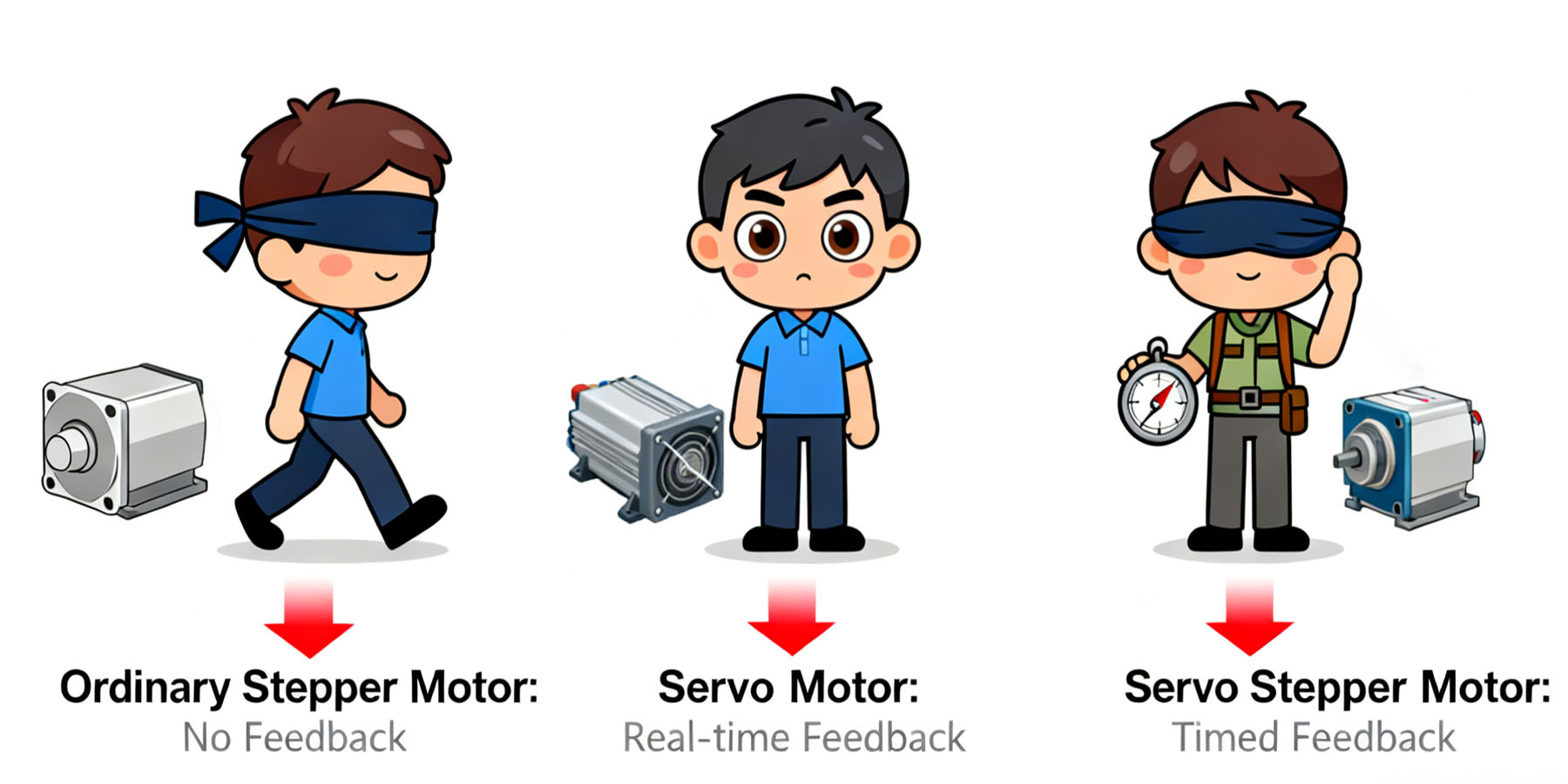
An open-loop stepper motor system operates on faith. The controller sends a sequence of electrical pulses to the motor, each pulse theoretically rotating the shaft by one step. There’s no verification that the shaft actually moved. The controller counts pulses and assumes the shaft position matches.
This faith-based system works well under controlled conditions—constant load, moderate speed, no disturbances. But real-world conditions are rarely controlled:
- A sudden mechanical jam overloads the motor torque capability, and it misses steps
- An unexpected external force pushes the motor past its holding torque
- Resonance at certain speeds causes torque to drop precipitously
- Temperature changes affect friction coefficients and torque margins
- Wear and tear gradually increase friction, reducing the torque margin
When any of these events occur, the motor doesn’t move the expected distance. The controller, unaware of the error, continues operating as if everything is fine. The result is cumulative positioning error that compounds over time.
In a 3D printer, this might manifest as a layer shift—a visible defect in the printed part. In a CNC machine, it could mean a dimensional error that scraps an expensive workpiece. In a medical device, it could mean a dispensing error with serious consequences.
How Closed-Loop Stepper Technology Works
The Core Architecture
A closed-loop stepper system adds three components to the traditional stepper architecture:
- An encoder (typically mounted on the rear shaft of the motor) that measures the actual rotor position
- A feedback processing circuit in the drive that compares the commanded position (based on step pulses received) with the actual position (from the encoder)
- A correction mechanism that adds or subtracts pulses to close the position gap
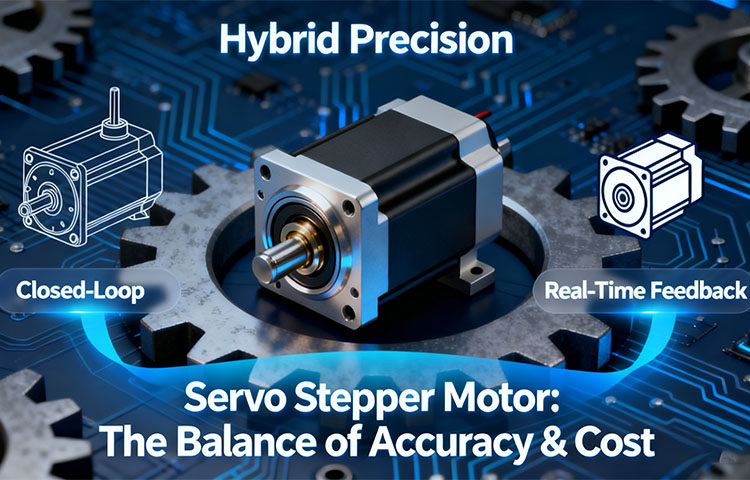
The result is a system that maintains the simplicity of step-and-direction control from the controller’s perspective, while adding the reliability of position verification.
Encoder Technology
Most closed-loop stepper systems use one of two encoder types:
Magnetic encoders use a magnetized ring on the motor shaft and a Hall effect sensor array. They’re compact, robust, and inexpensive. Typical resolution is 12-14 bits (4,096 to 16,384 counts per revolution). They’re immune to dust, oil, and vibration, making them well-suited for harsh industrial environments.
Optical encoders use a glass or plastic code disc with fine lines, read by an LED-photodetector pair. They offer higher resolution (17-23 bits is common) and better accuracy, but are more fragile and sensitive to contamination.
For most closed-loop stepper applications, magnetic encoders provide more than sufficient resolution. The motor itself has mechanical tolerances (tooth geometry, bearing runout) that limit positioning accuracy to roughly ±3-5 arc-minutes regardless of encoder resolution.
Correction Modes
Different manufacturers implement the feedback loop differently, but the approaches generally fall into two categories:
Position correction mode: The drive continuously compares the commanded position (derived from incoming step pulses) with the actual encoder position. If a discrepancy is detected, the drive generates additional step pulses to close the gap. This correction happens transparently—the external controller doesn’t need to know about it.
Stall detection mode: The drive monitors for the onset of stalling (when the position error exceeds a threshold) and either generates an alarm signal or automatically applies corrective action. This mode is simpler but doesn’t actively correct position—it just warns you.
Position correction mode is generally preferred because it provides true closed-loop performance. Stall detection mode is useful as a safety feature in applications where you want to know about problems but can tolerate the position error.
What Happens During Normal Operation
Under normal conditions (light to moderate load, well within the motor’s torque capability), a closed-loop stepper operates almost identically to an open-loop stepper. The drive follows the step pulses, and the encoder confirms that the rotor is tracking correctly. No correction is needed.
The interesting behavior emerges at the edges of the operating envelope:
Near the torque limit: As load torque approaches the motor’s available torque, the rotor begins to lag behind the commanded position. An open-loop system would simply stall at this point. A closed-loop system detects the lag, adds correction pulses, and may temporarily increase motor current to provide additional torque. If the stall is inevitable (the load truly exceeds the motor’s capability), the drive generates a fault signal before significant position error accumulates.
During rapid acceleration: When accelerating a high-inertia load, the motor must overcome both the load inertia and friction. Open-loop systems risk missed steps if the acceleration profile is too aggressive. Closed-loop systems detect and correct any position lag, allowing more aggressive acceleration profiles.
After a disturbance: If an external force pushes the motor from its position, a closed-loop stepper automatically returns to the correct position. An open-loop stepper stays wherever the disturbance left it.
Performance Characteristics
Torque-Speed Curve: The Key Difference
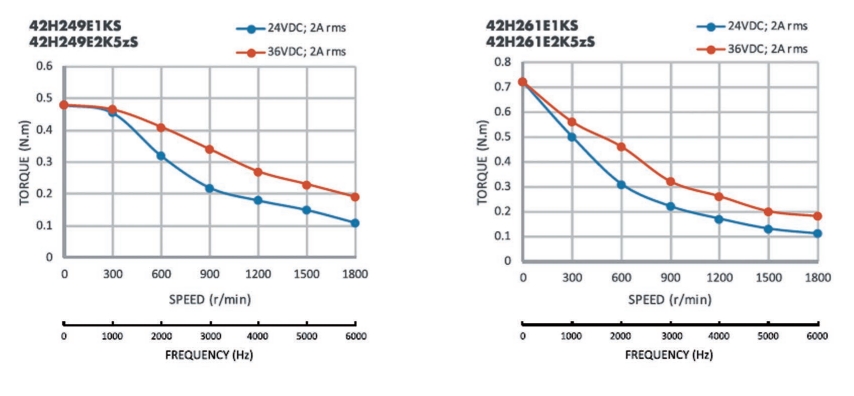
The torque-speed curve of a closed-loop stepper differs from its open-loop counterpart in an important way. In an open-loop system, the usable torque at any speed is limited by the pull-out torque—the point where the motor loses synchronism. You must maintain a significant safety margin (typically 50%) below this limit.
In a closed-loop system, you can operate closer to the pull-out torque because the feedback loop detects incipient stall and applies corrections. This effectively increases the usable torque at each speed point—typically by 20-40% compared to the safe operating limit for open-loop.
This doesn’t mean the closed-loop motor produces more torque. The motor’s physical torque capability is the same. But you can use more of it with confidence because the system detects and corrects for conditions that would cause missed steps in open-loop operation.
Accuracy and Repeatability
A closed-loop stepper’s positioning accuracy is limited by:
- Motor step angle: A 1.8° motor with 256× microstepping has a theoretical resolution of 0.007°. The closed-loop system ensures the motor actually reaches each commanded position.
- Encoder resolution: The feedback system can only correct to the encoder’s resolution. A 12-bit magnetic encoder has 4,096 counts per revolution (0.088° resolution).
- Mechanical tolerances: Bearing runout, shaft compliance, and coupling backlash typically add 2-5 arc-minutes of uncertainty.
For practical purposes, a closed-loop stepper with a 12-bit encoder achieves ±0.05° positioning accuracy—significantly better than an open-loop stepper (which can only guarantee accuracy if no steps are missed) but not quite matching a servo system with a high-resolution encoder (which can achieve ±0.01° or better).
Repeatability is excellent—the ability to return to the same position repeatedly. Because the encoder provides consistent feedback, repeatability is typically better than absolute accuracy, often reaching ±0.02° or better.
Dynamic Performance
The dynamic performance of a closed-loop stepper is still fundamentally limited by the stepper motor’s physics:
- Speed range: Still limited by torque rolloff at high speed (same as open-loop)
- Acceleration: Better than open-loop (can use correction to push closer to torque limit), but still not matching servo performance
- Bandwidth: Limited by the stepping rate and the correction loop response time
The key improvement over open-loop is reliability, not raw performance. A closed-loop stepper won’t make your machine faster—it will make it more reliable.
Efficiency Improvements
One often-overlooked benefit of closed-loop stepper technology is improved energy efficiency. Because the drive knows the actual motor position, it can implement smart current management:
- Current reduction at standstill: When the motor is holding position with no load, the drive can reduce the current to the minimum needed to maintain position (determined by encoder feedback). This can reduce standby power consumption by 50-70%.
- Current reduction during light-load operation: When the load is lighter than expected, the drive can reduce current accordingly.
- Peak current on demand: When extra torque is needed (detected by position lag), the drive can briefly increase current above nominal.
The net result is typically 20-40% reduction in energy consumption compared to a traditional stepper drive running at full current continuously.
Comparing Closed-Loop Steppers to Alternatives
Closed-Loop Stepper vs Open-Loop Stepper
| Feature | Open-Loop | Closed-Loop |
|---|---|---|
| Position certainty | No (faith-based) | Yes (encoder verified) |
| Stall detection | No | Yes |
| Usable torque margin | 50% safety factor | 20-30% safety factor |
| Energy consumption | High (constant current) | 20-40% lower |
| Cost | Low | 30-50% higher |
| Complexity | Simple | Moderate |
| Setup time | Minimal | Slightly more |
The closed-loop stepper is a clear upgrade in reliability and efficiency. The question is whether the extra cost is justified for your application.
Closed-Loop Stepper vs Servo Motor
| Feature | Closed-Loop Stepper | Servo Motor |
|---|---|---|
| Control algorithm | Step following + correction | Full PID loop |
| Torque production | Discrete (stepping) | Continuous (sinusoidal) |
| Smoothness at low speed | Good (microstepping) | Excellent |
| High-speed torque | Limited (same as stepper) | Excellent |
| Peak torque | 2-3× continuous | 3-5× continuous |
| Bandwidth | 50-100 Hz | 200-1000 Hz |
| Tuning | Minimal | Significant |
| Cost | Moderate | High |
| Encoder | Magnetic (12-14 bit) | Optical (17-23 bit) |
The critical difference is in the control architecture. A closed-loop stepper still drives the motor in discrete steps—the correction loop just ensures the steps actually happen. A servo motor uses continuous sinusoidal commutation (typically FOC) for inherently smooth rotation.
For applications requiring the highest dynamic performance (high-speed contouring, rapid acceleration, smooth low-speed operation), servos are superior. For applications where stepper-level performance is adequate but reliability is essential, closed-loop steppers offer the best value.
Applications Where Closed-Loop Steppers Excel
CNC Routers and Mills (Mid-Range)
Mid-range CNC machines often use open-loop steppers for cost reasons. The occasional missed step causes visible machining defects and wasted material. Closed-loop steppers eliminate this failure mode while maintaining the cost advantage over servos.
This is especially valuable for production machining where a single scrapped part can cost hundreds of dollars in material and machine time.
Medical and Laboratory Automation
Medical devices have zero tolerance for unreported positioning errors. A closed-loop stepper provides both the accuracy needed for precise fluid handling, sample positioning, and the reliability assurance required for medical device certification.
Semiconductor Manufacturing
Cleanroom environments favor stepper systems (no encoder seals to worry about in vacuum conditions, simpler cabling). The position certainty of closed-loop operation is essential for wafer handling and inspection equipment.
Textile and Packaging Machinery
These industries run at high speed with frequent direction reversals. The high inertia of moving materials (fabric rolls, product packages) creates variable loads that can push open-loop steppers past their torque limits. Closed-loop steppers handle these conditions reliably.
3D Printing (Professional Grade)
Consumer 3D printers almost universally use open-loop steppers—they’re cheap, simple, and adequate for hobby use. Professional 3D printers serving engineering and manufacturing applications increasingly use closed-loop steppers to eliminate layer shifts and ensure dimensional accuracy for functional parts.
Automated Test Equipment
ATE systems perform repetitive positioning sequences thousands of times per day. Any positioning error can produce invalid test results. Closed-loop steppers provide the consistency needed for reliable testing.
What to Look for When Selecting a Closed-Loop Stepper
Motor and Drive as a System
Don’t buy the motor and drive separately unless you’re sure they’re compatible. The encoder interface, communication protocol, and current regulation parameters must match between the motor’s encoder and the drive’s processing capabilities.
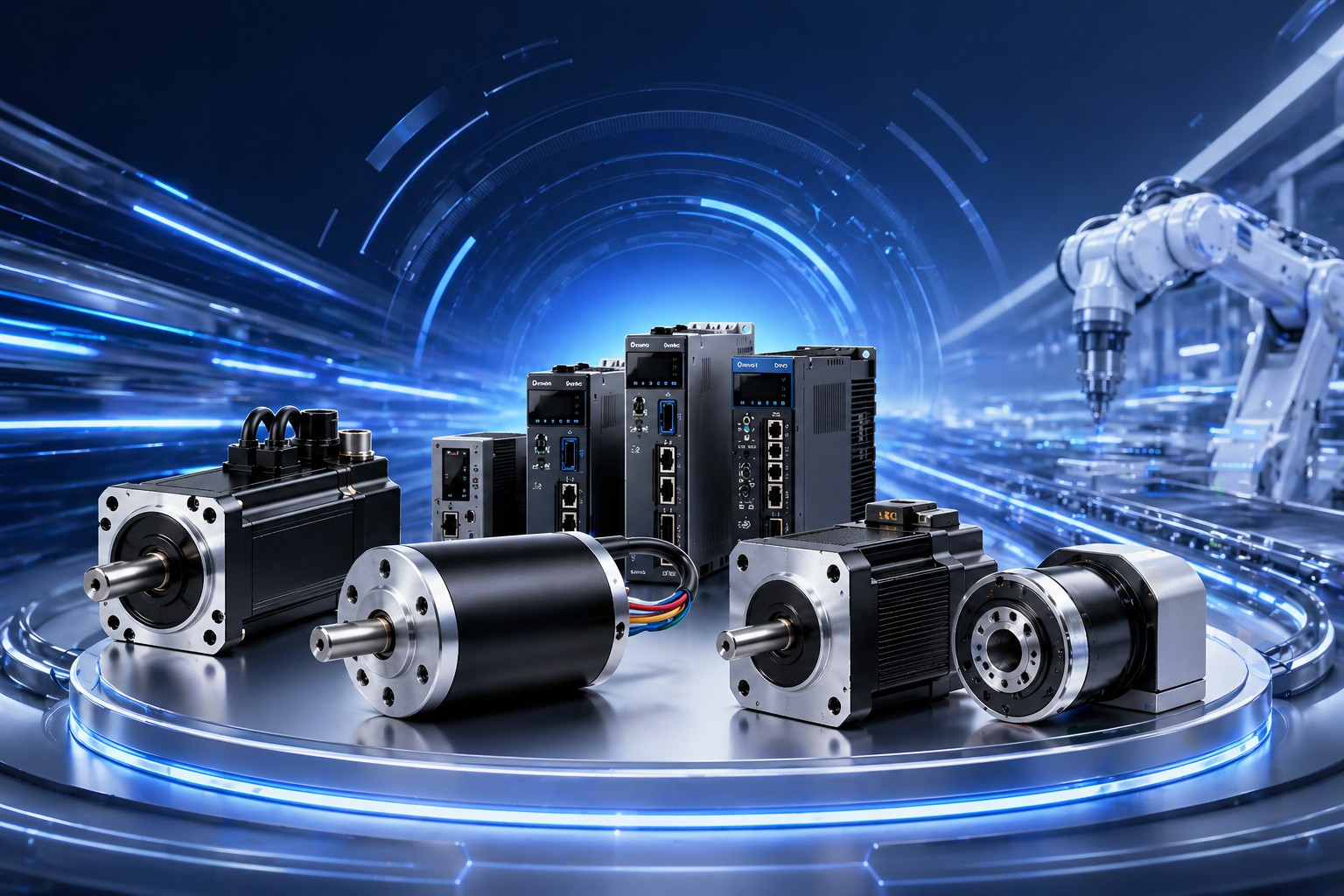
Many manufacturers (including ZGC Motors) offer matched motor-drive combinations that are factory calibrated and tested together.
Encoder Type and Resolution
For most applications, a magnetic encoder with 4,096-16,384 counts per revolution is sufficient. Consider higher resolution optical encoders only if your application requires sub-arc-minute accuracy.
Stall Response Configuration
Look for drives that offer configurable stall response:
– Auto-correction: The drive automatically corrects position errors (always enabled)
– Alarm output: A digital output that activates when position error exceeds a threshold
– Fault shutdown: The drive shuts down and locks the motor when stall is detected
The right configuration depends on your application’s safety requirements and fault handling strategy.
Current Management Features
Evaluate the drive’s current management capabilities:
– Automatic current reduction: Reduces current when the motor is stationary
– Adaptive current: Adjusts current based on load (inferred from position error)
– Peak current capability: How much additional current can the drive provide during correction?
– Thermal monitoring: Overtemperature protection with graceful derating
Communication Interface
Consider how the drive integrates with your control system:
– Step/direction (backward compatible with existing stepper controllers)
– CANopen or EtherCAT for industrial bus integration
– Serial/UART for simple parameter configuration and monitoring
– Analog input for speed or torque control mode
Installation and Commissioning Tips
Mechanical Installation
- Coupling alignment: Proper shaft alignment between the motor and load is critical for closed-loop stepper reliability. Misalignment causes cyclic torque disturbances that the correction loop must constantly fight, increasing current consumption and heat generation.
- Encoder connector security: The encoder cable is the most vulnerable connection in the system. Use locking connectors and proper cable routing to prevent damage.
- Vibration isolation: If the driven mechanism produces significant vibration, consider a flexible coupling to isolate the motor’s encoder from the vibration source.
Electrical Installation
- Shielded encoder cables: Always use shielded cables for the encoder connection. Encoder signals are low-level and susceptible to EMI from motor cables and power electronics.
- Separate cable routing: Run encoder cables separately from motor power cables. If they must cross, cross at right angles.
- Proper grounding: Connect the encoder cable shield to the drive’s ground terminal, not to the motor chassis. A ground loop through the encoder can inject noise into the position feedback signal.
Commissioning
- Verify step direction: Confirm that positive step pulses produce rotation in the expected direction. A direction mismatch will cause the correction loop to fight the motion, potentially damaging the drive.
- Check encoder alignment: The encoder’s zero position should correspond to a known motor position. Most drives have a calibration routine—run it before first operation.
- Set current limits: Start with the motor’s rated current and verify thermal performance under your actual load conditions before adjusting.
- Test stall response: Deliberately stall the motor (with a controlled load) and verify that the alarm output activates and the motor recovers correctly when the load is removed.
Limitations and When Not to Use Closed-Loop Steppers
Despite their advantages, closed-loop steppers aren’t the answer to every motion control problem:
High-speed applications: Above 2000 RPM, the torque advantage of servos becomes decisive. If your application requires sustained operation at high speed, a servo system is more efficient and cost-effective.
Ultra-precise positioning: For sub-arc-minute accuracy and sub-micron linear positioning, servos with high-resolution encoders and advanced control algorithms are still superior.
Contouring and complex trajectories: Applications requiring smooth path following (CNC machining of complex contours, laser cutting, coordinate measuring machines) benefit from the continuous torque production and high bandwidth of servo systems.
Very high inertia loads: When the load inertia exceeds the motor inertia by more than 10:1, even closed-loop correction may not prevent stall under rapid acceleration. A gearbox or a larger motor (servo) is needed.
The Market Landscape
The closed-loop stepper market has been growing at approximately 12-15% annually, significantly outpacing the broader motion control market. Major manufacturers including Oriental Motor, NEMA, Leadshine, and ZGC Motors now offer comprehensive closed-loop stepper product lines.
The technology is maturing rapidly. Early closed-loop stepper drives were essentially open-loop drives with an encoder bolted on. Today’s drives feature sophisticated digital signal processing, adaptive current management, and communication capabilities that rival entry-level servo systems.
Frequently Asked Questions
Can I retrofit an existing open-loop stepper system with closed-loop capability?
In many cases, yes. If your existing motor has a rear shaft extension, you can add an encoder kit. However, the motor and drive must be from the same manufacturer or have compatible encoder interfaces. It’s often more practical to replace both motor and drive as a matched set.
Is closed-loop stepper technology more reliable than open-loop?
The motor itself is equally reliable—the stepper motor has no brushes or wearing electrical parts. The added encoder is an additional component that can fail, but modern magnetic encoders are extremely robust with MTBF ratings exceeding 50,000 hours. The net effect is a more reliable system overall because the feedback eliminates the dominant failure mode of open-loop systems (missed steps).
How does cost compare between closed-loop stepper and servo?
A closed-loop stepper system typically costs 50-70% of an equivalent servo system. The savings come from the simpler drive electronics, the lower-performance encoder, and the less sophisticated control algorithm. For multi-axis systems (4-8 axes), the cost advantage becomes very significant.
Can closed-loop steppers do regenerative braking?
Most closed-loop stepper drives don’t implement regenerative braking. The drive can decelerate the motor quickly by reversing current, but the energy is dissipated as heat in the motor and drive rather than being returned to the power supply. For applications requiring energy recovery, servo systems are more appropriate.
What happens if the encoder fails?
Most drives detect encoder failure through a built-in self-test or a watchdog circuit. When encoder failure is detected, the drive typically transitions to open-loop mode (if configured to do so) or shuts down with a fault indication. The system doesn’t become dangerous—it just loses the closed-loop advantage.
Do I need to tune a closed-loop stepper like a servo?
Generally no. The correction loop parameters are pre-set by the manufacturer and work well for the matched motor-drive combination. Some advanced drives offer tuning parameters, but the default values are usually adequate. This is a significant advantage over servo systems, which typically require careful PID tuning.
Is there a speed limit for closed-loop correction?
Yes. The correction loop has a finite bandwidth. At very high stepping rates, the drive may not be able to detect and correct errors fast enough. In practice, most closed-loop stepper drives maintain correction capability up to 2000-3000 RPM. Above that, the system effectively operates in open-loop mode—still benefiting from stall detection but with reduced correction capability.
Need Help Selecting the Right Motor?
ZGC Motors offers a complete range of BLDC motors, servo motors, stepper motors, and motor controllers for industrial, automotive, and outdoor power applications. Our engineering team can help you find the perfect solution for your project.