PMSM Motors Explained: Why Permanent Magnet Synchronous Machines Power Everything from EVs to Factory Floors
Here’s something that confuses a lot of engineers: a PMSM motor and a BLDC motor are, physically speaking, the same thing. Both have permanent magnets on the rotor and wound copper coils on the stator. The difference isn’t in the hardware—it’s in how you drive it.
Table of Contents
The distinction between “BLDC motor” and “PMSM motor” is largely a matter of naming convention, commutation method, and the shape of the back-EMF waveform. But this distinction has enormous practical implications for how the motor performs, what controller it needs, and where it gets used. Understanding PMSM technology isn’t academic—it’s the key to selecting the right motor for high-performance applications.
This article cuts through the naming confusion, explains the physics that make PMSM motors exceptional, and covers the practical aspects of selecting, driving, and applying these motors in real systems.
The BLDC vs PMSM Naming Confusion

What’s Actually the Same
Both BLDC and PMSM motors share identical fundamental construction:
- Permanent magnets on the rotor (typically NdFeB—neodymium iron boron)
- Three-phase windings on the stator
- No brushes, no commutator
- The stator creates a rotating magnetic field that drags the rotor along
If you took a “BLDC motor” and a “PMSM motor” with the same frame size, winding configuration, and magnet arrangement, you literally could not tell them apart by looking at them.
What’s Actually Different
The meaningful differences are:
Back-EMF waveform shape: BLDC motors are designed for trapezoidal back-EMF. PMSM motors are designed for sinusoidal back-EMF. In practice, most real motors have a waveform somewhere between trapezoidal and sinusoidal—it’s a spectrum, not a binary choice.
Commutation method: BLDC motors are typically driven with six-step (trapezoidal) commutation. PMSM motors are driven with sinusoidal commutation, usually implemented as Field Oriented Control (FOC).
Winding distribution: BLDC motors often use concentrated windings (one coil per tooth, short end turns). PMSM motors often use distributed windings (coils span multiple teeth, longer end turns but smoother MMF). Again, this is a tendency, not a rule.
The practical upshot: When someone says “PMSM motor,” they typically mean a motor designed for sinusoidal drive and high performance. When they say “BLDC motor,” they typically mean a motor designed for simpler trapezoidal drive. But the hardware overlaps significantly, and many modern motors work well with either drive method.
The Physics of PMSM Torque Production
Magnetic Flux Interaction
A PMSM motor produces torque through the interaction of two magnetic fields:
- The rotor’s permanent magnet field, which rotates with the rotor
- The stator’s electromagnetic field, created by currents in the three-phase windings
Maximum torque occurs when these fields are perpendicular (90° apart). The controller’s job is to maintain this optimal angle by continuously adjusting the stator currents based on the rotor position.
The Torque Equation
For a PMSM motor, the electromagnetic torque can be expressed as:
T = (3/2) × p × [ψ_m × Iq + (Ld – Lq) × Id × Iq]
Where:
– p = number of pole pairs
– ψ_m = permanent magnet flux linkage
– Iq = q-axis current (torque-producing)
– Id = d-axis current (flux-producing)
– Ld = d-axis inductance
– Lq = q-axis inductance
This equation reveals something important: there are two torque components:
Magnet torque: ψ_m × Iq — the primary torque from the interaction of the permanent magnets with the stator current. This is the dominant torque component in most PMSM motors.
Reluctance torque: (Ld – Lq) × Id × Iq — additional torque from the difference in inductance between the d-axis and q-axis. This is significant in motors designed with reluctance torque (called IPM—Interior Permanent Magnet motors).
Surface-Mounted vs Interior Permanent Magnets
The arrangement of magnets on the rotor significantly affects the motor’s characteristics:
Surface Permanent Magnet (SPM): Magnets are bonded to the rotor surface. The air gap is effectively uniform, making Ld ≈ Lq. There’s no reluctance torque—only magnet torque. SPM motors are simpler to manufacture and have lower cogging torque.
Interior Permanent Magnet (IPM): Magnets are buried inside the rotor lamination. The different magnetic reluctance along the d-axis (through the magnet) and q-axis (between magnets) creates Ld < Lq, enabling reluctance torque. IPM motors can produce higher torque density and enable field weakening for extended speed range. They’re the standard choice for EV traction motors.
Operating Principles in Different Quadrants
A PMSM motor can operate in four quadrants:
- Q1: Forward motoring (positive torque, positive speed)
- Q2: Forward braking / regeneration (negative torque, positive speed)
- Q3: Reverse motoring (negative torque, negative speed)
- Q4: Reverse braking / regeneration (positive torque, negative speed)
This four-quadrant capability is inherent to the motor and drive—it requires no mechanical switching or additional components. Regenerative braking (Q2 and Q4) is particularly valuable in electric vehicles and battery-powered systems for recovering kinetic energy.
PMSM Motor Design Considerations
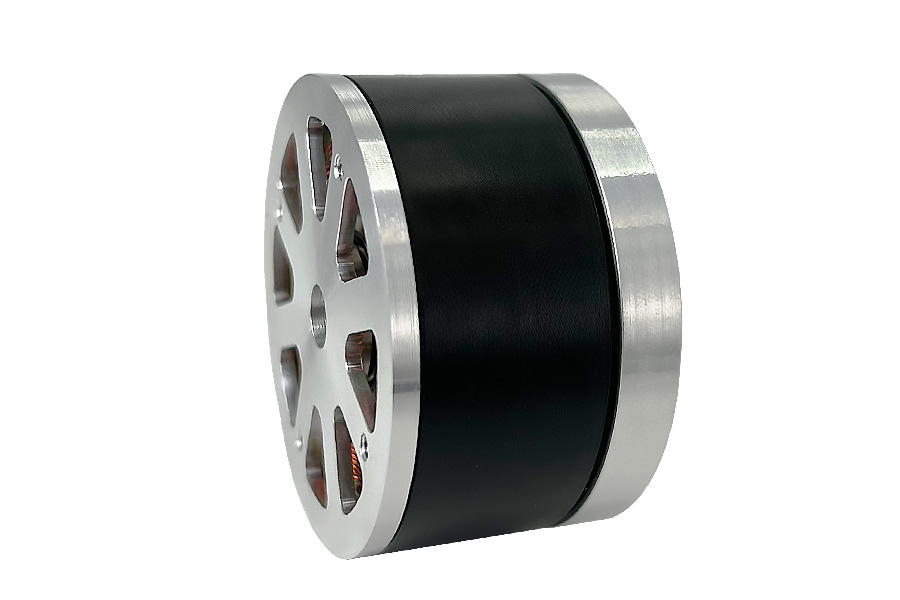
Pole Count Selection
The number of magnetic poles on the rotor is a fundamental design parameter:
- 2-4 poles: High speed, low torque applications. Common in small servos and precision instruments.
- 6-8 poles: The workhorse range for industrial PMSM motors. Good balance of speed and torque.
- 10-16 poles: Higher torque density, lower speed. Common in direct-drive applications, electric vehicles, and larger industrial motors.
- 20+ poles: Very low speed, very high torque. Used in wind turbine generators, large direct-drive motors, and some wheel hub motors.
More poles means higher torque at a given current (because each pole pair contributes torque) but lower maximum speed (because the electrical frequency increases with both speed and pole count). The electrical frequency limit is set by the core losses (eddy currents and hysteresis) in the stator iron.
As a rule of thumb, the electrical frequency (in Hz) at maximum speed should not exceed 400-600 Hz for standard lamination steel. Special high-frequency lamination materials can push this to 1000+ Hz, at increased material cost.
Magnet Material Selection
NdFeB (neodymium) magnets dominate the PMSM market due to their high energy product (the measure of magnet strength). The key grade parameters:
- Energy product (N35 to N52): Higher grades produce stronger magnetic fields but are more expensive and more susceptible to temperature demagnetization
- Temperature rating: N (normal, up to 80°C), M (medium, up to 100°C), H (high, up to 120°C), SH (super high, up to 150°C), UH (ultra high, up to 180°C)
For most industrial and automotive applications, N38SH or N42SH provides an excellent balance of magnetic strength and thermal stability. The “SH” rating ensures the magnets don’t demagnetize at the elevated temperatures encountered during heavy load operation.
Stator Winding Configurations
Distributed windings: Each coil spans multiple teeth (typically 2/3 or 5/6 of the pole pitch). This produces a more sinusoidal MMF distribution, which is ideal for PMSM operation. The trade-off is longer end turns (more copper, more weight, more copper loss).
Concentrated (fractional-slot) windings: Each tooth has one coil, and the coils don’t overlap. This gives shorter end turns (less copper loss, more compact) but a less sinusoidal MMF. Modern fractional-slot combinations (like 12-slot/10-pole) can produce surprisingly sinusoidal back-EMF despite concentrated windings.
Toroidal windings: The coils are wound around the stator back iron rather than around individual teeth. This gives the most sinusoidal MMF and highest winding factor, but is difficult to manufacture and rarely used.
Slot/Pole Combinations
The number of stator slots relative to the number of rotor poles affects the motor’s characteristics:
- 9-slot/8-pole: Very common, good balance of winding factor and cogging torque
- 12-slot/10-pole: Excellent for PMSM, low cogging, sinusoidal back-EMF with concentrated windings
- 24-slot/20-pole: Smooth operation, good for higher pole counts
- 36-slot/8-pole: Distributed winding configuration, very sinusoidal, used in larger motors
The choice affects cogging torque (the tendency of the rotor to “click” into preferred positions), winding factor (how effectively the winding couples to the magnetic field), and the harmonic content of the back-EMF.
Control Strategies for PMSM Motors
Field Oriented Control (FOC)
FOC is the standard control method for PMSM motors. As covered in detail in our FOC guide, the process involves:
- Measuring phase currents
- Clarke transform (3-phase → 2-axis stationary frame)
- Park transform (stationary → rotating frame, using rotor angle)
- PI control of Id and Iq independently
- Inverse Park transform
- Space vector modulation
- PWM generation
For PMSM motors specifically:
– Id is typically driven to zero (to maximize efficiency, since the magnets provide all needed flux)
– Iq is controlled to produce the desired torque
– The torque response is fast and linear (T = Kt × Iq)
Maximum Torque Per Ampere (MTPA)
For IPM motors where reluctance torque exists, MTPA is an optimization strategy that finds the Id/Iq combination producing maximum torque for a given total current magnitude. This involves solving:
d(T)/d(Id) = 0 (subject to Id² + Iq² = I_max²)
The result is a current vector angle that’s slightly off the pure q-axis, utilizing some reluctance torque to boost total output. MTPA can provide 5-15% additional torque compared to pure Iq control in IPM motors.
Field Weakening Control
As discussed in the FOC article, field weakening allows operation above the base speed by introducing negative Id to reduce the effective flux. For PMSM motors, field weakening is particularly important for:
- EV traction: Wide speed range (0-12,000+ RPM) from a battery voltage that limits the base speed
- Spindle applications: High-speed machining requiring constant power over a wide speed range
- Compressors: Variable-speed operation with efficiency optimization across the speed range
The maximum achievable speed with field weakening depends on:
– The characteristic current (the short-circuit current, related to magnet strength and d-axis inductance)
– The DC bus voltage
– The motor’s thermal limits (field weakening causes additional copper loss)
Direct Torque Control (DTC)
An alternative to FOC that directly controls torque and flux using hysteresis comparators and a switching table. DTC offers faster torque response than FOC but with higher torque ripple and more variable switching frequency. It’s used in some industrial drives and automotive applications where torque response speed is paramount.
Sensorless Control
For applications where adding an encoder is undesirable (cost, space, reliability), sensorless control estimates rotor position from measurable electrical quantities:
- Back-EMF-based methods: Work well at medium to high speeds (above 10-20% of rated speed)
- High-frequency injection (HFI): Works at low and zero speed but adds losses and noise
- Model reference adaptive systems (MRAS): Use a reference model and adaptive model to estimate position
- Sliding mode observers (SMO): Robust to parameter variations but can produce chattering
Sensorless PMSM control has improved dramatically in recent years and is now viable for many applications. However, for the highest performance applications (servo systems, EV traction), encoder-based control remains the gold standard.
Loss Mechanisms and Efficiency
Copper Losses
Copper losses (I²R losses) in the stator windings are typically the dominant loss mechanism at low to medium speeds:
P_copper = 3 × I_rms² × R_phase
Where R_phase is the phase resistance including the end turns. Copper losses increase with the square of current, so they’re especially significant at high torque.
Design strategies to reduce copper losses:
– Increase wire gauge (more copper cross-section, lower resistance)
– Shorten end turns (concentrated windings, or optimized winding geometry)
– Use higher slot fill factor (more copper in each slot)
– Higher voltage operation (less current for the same power)
Iron (Core) Losses
Iron losses in the stator laminations consist of:
- Hysteresis loss: Proportional to frequency and proportional to B^(1.6-2.0) where B is the flux density
- Eddy current loss: Proportional to frequency² and proportional to B²
Iron losses dominate at high speeds. They’re reduced by:
- Thin lamination steel (0.35mm or 0.5mm vs 1mm) to reduce eddy current paths
- High-grade silicon steel with low hysteresis loss
- Optimized flux density levels (avoiding saturation)
- Segmented or powder metallurgy cores for specialized high-frequency applications
Magnet Losses
NdFeB magnets have finite electrical conductivity, which means time-varying magnetic fields can induce eddy currents in the magnets themselves. These eddy currents cause:
- Additional heating (which can demagnetize the magnets at high temperatures)
- Reduced magnet effectiveness
Magnet losses are reduced by:
– Segmenting the magnets (cutting them into smaller pieces to break up eddy current paths)
– Using magnet material with lower conductivity (some grades are formulated for this)
– Minimizing slot harmonics in the stator MMF (through winding design and skewing)
Mechanical Losses
Mechanical losses include bearing friction, windage (air friction on the rotor), and seal drag. These are typically small compared to electrical losses but become significant at very high speeds.
Total Efficiency Map
A PMSM motor’s efficiency varies significantly across its operating range. The efficiency is highest near rated torque and rated speed, and drops at:
- Very low torque (iron and mechanical losses represent a large fraction of total loss)
- Very high speed (iron losses dominate)
- Very high torque (copper losses dominate)
When selecting a motor, examine the efficiency map (contour plot of efficiency vs speed and torque) to verify adequate efficiency at your actual operating points, not just at the rated point.
Thermal Management
Temperature Limits
The critical temperature limits in a PMSM motor are:
- Winding temperature: Limited by insulation class (B=130°C, F=155°C, H=180°C)
- Magnet temperature: Limited by the magnet grade’s maximum operating temperature. Exceeding this causes irreversible demagnetization—the motor loses torque permanently.
- Bearing temperature: Limited by lubricant degradation (typically 100-120°C for standard grease)
The most critical limit is usually the magnet temperature. A PMSM motor that overheats its magnets doesn’t just need to cool down—it needs replacement. This is a fundamental difference from induction motors, which have no permanent magnets to damage.
Cooling Methods
Natural convection: The simplest approach. The motor housing dissipates heat to the surrounding air. Adequate for low-duty-cycle applications.
Forced air cooling: A fan (either on the motor shaft or separately driven) forces air over the motor housing or through internal cooling channels. This can significantly increase the continuous power rating.
Liquid cooling: Water or oil is circulated through cooling jackets or internal passages in the motor housing. This provides the highest cooling capacity and is standard for EV traction motors and large industrial PMSM motors.
Frame cooling: The motor is mounted to a thermally conductive surface (a machine frame, heat sink, or cold plate) that conducts heat away.
Application Examples
Electric Vehicle Traction
EV traction is the highest-profile application for PMSM motors. Key requirements:
- Power: 50-200 kW per motor (passenger cars), up to 500+ kW for performance vehicles
- Speed range: 0-16,000 RPM with field weakening for highway speeds
- Efficiency: >95% at rated point, >85% across the WLTP drive cycle
- Thermal management: Liquid cooling with integrated jacket
- Packaging: Extremely compact, often integrated with the transmission and inverter
Most modern EVs use IPM (Interior Permanent Magnet) motors because the reluctance torque contribution improves efficiency and extends the speed range. Tesla’s Model 3 uses an IPM motor; the BMW i3, Nissan Leaf, and Hyundai Kona EV also use PMSM traction motors.
Industrial Servo Systems
Servo motors for factory automation are almost exclusively PMSM motors driven by FOC:
- Power range: 50W to 50kW+
- Encoder resolution: 17-23 bit absolute encoders
- Speed range: 0-6000 RPM (typical), up to 10,000+ RPM for high-speed models
- Key features: Low inertia, high acceleration, low cogging, wide speed range
The ZGC130SV200 Series (2000W, 130mm frame) is an example of a high-performance PMSM servo motor for industrial applications, offering high torque density and precision encoder feedback.
Wind Turbine Generators
Large wind turbines increasingly use PMSM generators, especially in direct-drive configurations (no gearbox):
- Power: 2-15 MW for utility-scale turbines
- Speed: 5-20 RPM (very low speed, high pole count)
- Cooling: Liquid or forced air cooling
- Challenge: The very large diameter rotors require massive magnets and precise manufacturing
The PMSM generator offers higher efficiency than the traditional DFIG (doubly-fed induction generator) at partial load, which is important because wind turbines spend most of their time at 30-70% of rated power.
Robotics
Robot joint motors benefit from PMSM characteristics:
- High torque density (important for compact robot joints)
- Smooth, ripple-free torque (critical for precise movement and force control)
- Wide speed range with field weakening
- High efficiency (reduces motor heating in enclosed robot structures)
Collaborative robots (cobots) increasingly use high-pole-count PMSM motors with integrated gearboxes and encoders for compact, precise joint actuation.
PMSM vs Induction Motor
The comparison between PMSM and induction motors is one of the most debated topics in motor technology:
| Feature | PMSM | Induction |
|---|---|---|
| Efficiency | Higher (no rotor losses) | Lower (5-10% rotor copper loss) |
| Power density | Higher | Lower |
| Speed range | Wide (with field weakening) | Limited (constant power above base speed) |
| Cost | Higher (rare earth magnets) | Lower |
| Magnet supply risk | Yes (rare earth dependency) | No |
| Rotor thermal management | Easier (no rotor losses) | Challenging (rotor copper losses must be dissipated) |
| Fault tolerance | PM demagnetization risk | More robust to faults |
For applications where efficiency, power density, and precise control matter (EVs, robotics, servos), PMSM wins decisively. For applications where cost, robustness, and supply chain security are paramount (large industrial pumps, fans, compressors), induction motors remain competitive.
Future Trends
Reduced Rare-Earth Motors
The dependence on rare-earth magnets (primarily neodymium from China) creates supply chain risk. Research is focused on:
- Ferrite magnet PMSM: Lower flux density but zero rare-earth content. Requires motor redesign for equivalent performance.
- Hybrid excited motors: Combine PM excitation with wound-field excitation for controllable flux.
- Switched reluctance motors: No magnets at all, but lower torque density and higher noise.
Higher Voltage Systems
The trend toward 800V battery systems in EVs (from 400V) enables:
– Faster charging
– Reduced cable weight (half the current for the same power)
– Smaller, lighter power electronics
– Challenges: Higher voltage-rated components, insulation requirements
Integrated Motor Drives
Combining the motor, inverter, and gearbox into a single integrated unit reduces size, weight, wiring complexity, and electromagnetic interference. This trend is well-established in EVs and spreading to industrial applications.
Advanced Materials
- SiC and GaN power electronics: Enable higher switching frequencies and higher temperatures
- Amorphous metal laminations: Dramatically reduce iron losses at high frequencies
- High-temperature magnet grades: Pushing the operating temperature limit toward 200°C
Frequently Asked Questions
Are PMSM and BLDC motors interchangeable?
In many cases, yes. A motor designed for trapezoidal drive can be driven with sinusoidal FOC, and vice versa (though with suboptimal performance in both cases). The practical differences are modest. However, motors specifically optimized for sinusoidal operation (distributed windings, designed for sinusoidal back-EMF) will perform noticeably better with FOC than with six-step commutation.
Why is PMSM more efficient than BLDC?
It’s not inherently more efficient. The efficiency depends on the drive method, not the motor type. A PMSM motor driven with FOC is more efficient than the same motor driven with six-step commutation because FOC minimizes current harmonics and maintains optimal current vector alignment. If you drive a “BLDC motor” with FOC, you get the same efficiency benefit.
Can PMSM motors be used with simple trapezoidal controllers?
Yes, but you’ll sacrifice some performance. The motor will have higher torque ripple, more acoustic noise, and lower efficiency than with sinusoidal FOC. For cost-sensitive applications where smoothness and efficiency aren’t critical, this may be acceptable.
What happens if a PMSM motor overheats?
The magnets lose strength with temperature (reversible if below the Curie temperature). If the temperature exceeds the magnet grade’s maximum rating, permanent demagnetization occurs—the motor will never recover its original torque capability. This is the most serious failure mode of PMSM motors and must be prevented through proper thermal management and protection.
How do I test if a motor is PMSM or induction?
Several methods: Spin the motor by hand—a PMSM motor will produce a detectable back-EMF and feel “coggy” due to the magnets. An induction motor will spin freely with no cogging. You can also measure the resistance between any two phases and look for the relatively low resistance of a PMSM stator (typically 0.5-5 ohms for small motors) versus the higher resistance of an induction motor rotor circuit.
Is PMSM suitable for very high-speed applications?
PMSM motors can operate at high speeds, but there are limitations: iron losses increase with speed², the rotor surface speed is limited by magnet retention (the magnets must be secured against centrifugal force), and the electrical frequency is limited by core losses. For very high-speed applications (above 20,000-30,000 RPM), special design considerations (solid rotor construction, carbon fiber magnet sleeves, high-frequency laminations) are needed.
Need Help Selecting the Right Motor?
ZGC Motors offers a complete range of BLDC motors, servo motors, stepper motors, and motor controllers for industrial, automotive, and outdoor power applications. Our engineering team can help you find the perfect solution for your project.