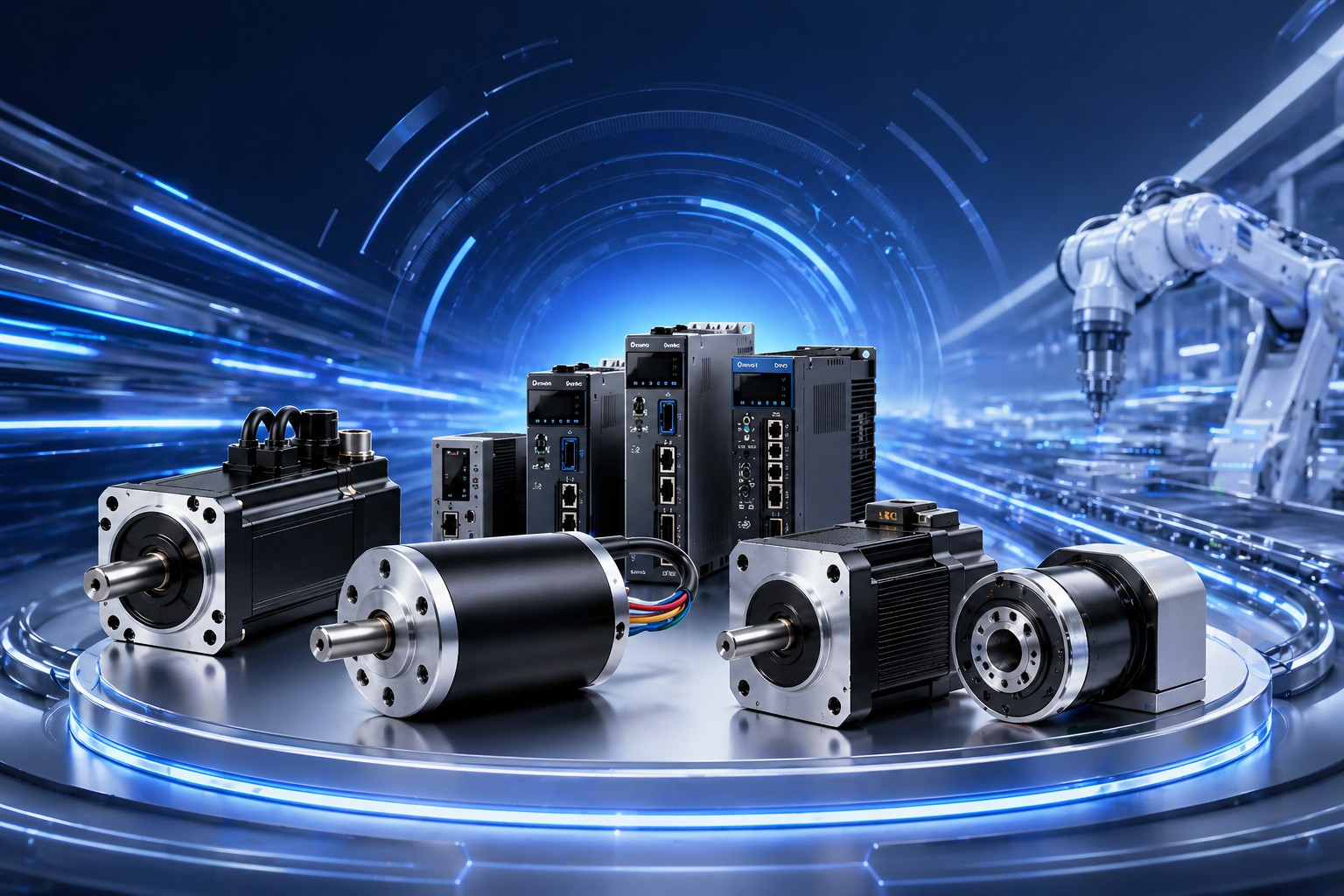
An integrated BLDC motor with driver combines the brushless DC motor, drive electronics, feedback interface, and often protection functions into a compact motion-control module. For OEM engineers, this can reduce wiring, simplify installation, shorten development time, and make the final machine easier to assemble and service.
This guide explains when an integrated BLDC motor is the right choice, when a separate BLDC motor and driver is still better, and what specifications to confirm before selecting a motor for industrial automation, logistics equipment, commercial appliances, medical devices, smart access systems, and compact robotic mechanisms.
What Is an Integrated BLDC Motor?
An integrated BLDC motor is a brushless DC motor designed with built-in or closely matched drive electronics. In a traditional system, the motor and driver are selected, mounted, wired, protected, and tested as separate components. In an integrated design, the supplier packages more of that work into one coordinated assembly.
The exact architecture varies by model. Some integrated motors include a compact built-in driver on the rear of the motor. Others use a matched motor-driver structure with standardized wiring, connectors, and control interfaces. The goal is the same: make brushless motor control easier for the equipment manufacturer.
ZGC Motors supplies integrated BLDC motor solutions for OEM applications that need compact size, stable speed control, reliable operation, and shorter system integration time.
Why OEMs Choose Integrated BLDC Motors
Separate motor and driver systems offer flexibility, but they also add wiring, enclosure space, thermal design work, and more points of failure. For many machines, especially compact equipment produced in repeatable volumes, integration can improve both engineering efficiency and production consistency.
Typical advantages include:
- Less wiring: Fewer external connections reduce assembly time and wiring mistakes.
- Compact layout: Motor and control electronics can fit into a smaller mechanical envelope.
- Faster development: The motor, driver, and feedback structure are already matched.
- Cleaner service: Replacing one integrated module can be easier than diagnosing multiple separate parts.
- Consistent performance: Matched components help reduce variation between production units.
- Lower system noise risk: Shorter wiring paths can reduce some electrical noise and installation sensitivity.
These benefits are strongest when the machine uses the same motion axis repeatedly, such as conveyor modules, small pumps, gates, rotating platforms, AGV subsystems, and commercial automation modules.
Integrated BLDC Motor vs Separate Motor and Driver
The best choice depends on control flexibility, installation space, thermal margin, production volume, and maintenance strategy.
Choose an integrated BLDC motor when:
- The machine needs a compact motion axis with repeatable performance.
- The required control mode is known and stable across production.
- Wiring reduction and assembly speed are important.
- The motor and driver can share the same operating environment.
- The project needs a clean, modular design for OEM production.
Choose a separate BLDC motor and driver when:
- The driver must be mounted away from heat, vibration, moisture, or mechanical shock.
- The project needs a higher-power drive than a compact integrated module can support.
- The control interface, communication protocol, or tuning requirements are still changing.
- Multiple motors will be controlled from a centralized cabinet.
- The system requires a driver with very specific I/O, braking, or network features.
If your system is still at the control-architecture stage, compare the integrated approach with a separate BLDC motor driver. A separate driver can be a better fit for higher-power or cabinet-based equipment, while an integrated motor can be better for compact distributed axes.
Common Applications
Integrated BLDC motors are useful anywhere the equipment needs stable rotation, compact packaging, and simplified wiring. The most common applications include:
- Conveyor modules: Compact drive axes for belts, rollers, and transfer systems.
- Logistics automation: Sorting machines, AGV subsystems, parcel handling, and warehouse equipment.
- Commercial appliances: High-efficiency drive modules for fans, pumps, and rotating assemblies.
- Medical devices: Compact motion axes where reliability, noise, and repeatability matter.
- Access systems: Gate, door, and barrier mechanisms that need smooth controlled motion.
- Robotic mechanisms: Small rotary joints, grippers, tool changers, and automated fixtures.
- Packaging equipment: Feeders, indexing axes, label handling, and light-duty conveyors.
For applications that need lower output speed and higher torque, an integrated motor can also be paired with a gearbox. If gearbox selection is the main question, read the BLDC gear motor selection guide.
Key Specifications to Confirm
Because integrated motors combine mechanical and electronic requirements, selection should cover more than rated power. Confirm the following details before choosing a model.
1. Voltage and power supply range
Confirm the available DC bus voltage, voltage tolerance, peak current capability, and supply protection. A motor that runs correctly on the bench may behave differently when installed near other loads or long cable runs.
2. Rated speed and speed range
Specify the normal working speed, minimum controllable speed, maximum speed, and speed regulation requirement. Integrated BLDC motors are often selected for smooth continuous rotation, so speed stability should be checked early.
3. Continuous torque and peak torque
Do not size the motor only by wattage. Calculate continuous torque, acceleration torque, friction, external load, and short peak loads. If the motor must start under load, reverse frequently, or drive a belt, torque margin becomes especially important.
4. Duty cycle and thermal environment
Integrated electronics make thermal design more important. Confirm ambient temperature, ventilation, mounting surface, enclosure design, and expected operating time. If the motor sits inside a sealed housing, derating may be needed.
5. Control interface
Common control options include analog speed input, PWM speed input, direction input, enable input, speed output, Hall feedback, encoder feedback, and communication with a main controller. The right interface depends on whether the equipment needs simple speed control or a more coordinated motion axis.
6. Protection functions
Review overcurrent, overvoltage, undervoltage, stall, overload, and overtemperature protection. These functions help protect the motor and driver, but the equipment controller should still handle abnormal machine conditions correctly.
7. Connector and cable design
Connectors and cables affect production efficiency, serviceability, and reliability. Confirm cable exit direction, connector type, wire length, shielding, strain relief, and whether the machine needs separate power and signal harnesses.
8. Mechanical mounting
Check motor frame size, flange pattern, shaft diameter, shaft length, flat or keyway, body length, gearbox compatibility, and available installation space. A compact motor is only useful if the cable, connector, and mounting orientation also fit the machine.
Control Options: Simple Speed Control or Closed Loop Motion?
Some integrated BLDC motors are used as efficient speed-controlled drives. Others need feedback and tighter control for automated equipment. The selection path depends on what the machine controller must know and command.
For a fan, pump, or rotating conveyor, the controller may only need start, stop, direction, and speed command. For a more advanced axis, the system may need speed feedback, fault feedback, position estimation, encoder signals, or communication with the main PLC or controller.
Field oriented control can improve smoothness, torque response, and efficiency in brushless motor systems. For more detail on this control method, see ZGC’s explanation of FOC motor drive control.
Integrated BLDC Motor Selection Checklist
- Define the load, output speed, continuous torque, and peak torque.
- Confirm available voltage, current capacity, and power-supply protection.
- Choose whether the application needs direct drive, gearbox, brake, or encoder.
- Confirm control inputs, feedback outputs, and communication needs.
- Check thermal margin in the real enclosure and duty cycle.
- Review connector, cable, shaft, flange, and mounting orientation.
- Prototype under real load before production release.
Questions to Send Your Motor Supplier
To get a useful recommendation, send the supplier more than a target power rating. A good request should include:
- Application and motion function.
- Supply voltage and available current.
- Target speed range and control method.
- Continuous torque, peak torque, and duty cycle.
- Ambient temperature and enclosure conditions.
- Mounting size, shaft design, and cable direction.
- Expected annual quantity and prototype schedule.
This information helps the engineering team recommend a motor that can survive the real load and fit the production design.
Why Work With ZGC Motors
ZGC Motors manufactures brushless DC motors, integrated BLDC motors, BLDC gear motors, motor drivers, servo motors, stepper motors, encoders, brakes, and customized motion-control assemblies. The company supports standard and customized solutions for OEM applications in industrial automation, logistics systems, commercial equipment, medical equipment, and other motion-control markets.
Explore the Integrated BLDC Motor category or contact ZGC Motors with your voltage, speed, torque, control, and mounting requirements.
FAQ
What is an integrated BLDC motor?
It is a brushless DC motor combined with built-in or closely matched driver electronics, making the motor easier to wire, install, and control in compact OEM equipment.
Is an integrated BLDC motor better than a separate motor and driver?
It is better when compact size, wiring reduction, and repeatable production are priorities. A separate driver is better when the project needs higher power, cabinet mounting, advanced communication, or more flexible control hardware.
Can an integrated BLDC motor use FOC control?
Yes, depending on the driver design. FOC can improve smoothness, efficiency, and torque response in brushless motor applications.
Can ZGC customize integrated BLDC motors?
Yes. ZGC can support custom voltage, speed, torque, shaft, mounting, cable, connector, feedback, brake, gearbox, and driver requirements for OEM projects.
Related guide: For OEM modules that need both compact BLDC drive integration and shaft holding, compare this article with the BLDC motor with brake and encoder guide.