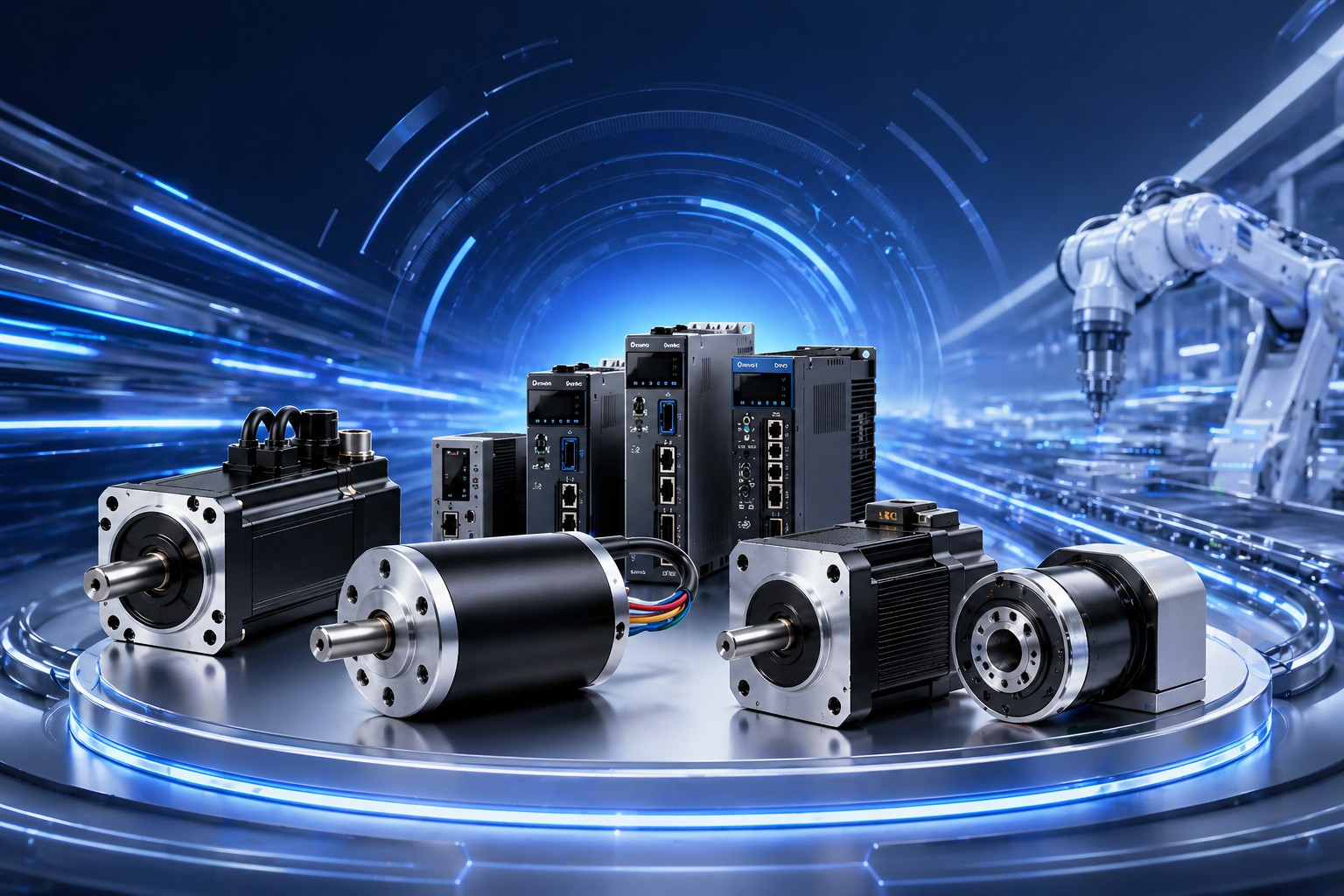
For many OEM motion systems, the motor itself is only one part of the selection problem. A vertical axis, indexing table, AGV lift module, packaging conveyor, electric door, medical adjustment stage or safety-related positioning mechanism may also need a holding brake and a feedback encoder. In those cases, specifying a BLDC motor with brake and encoder as an integrated electromechanical package can reduce assembly time, improve holding performance and make the control architecture easier to validate.
This guide explains when a brake and encoder are necessary, how to choose the right feedback and brake type, what electrical and mechanical details matter, and what information to prepare when asking ZGC Motors for a custom BLDC motor assembly.
What Is a BLDC Motor with Brake and Encoder?
A BLDC motor with brake and encoder combines three functions in one motion unit:
- Brushless DC motor: the torque source, selected by voltage, rated power, speed, torque, frame size and duty cycle.
- Brake: usually an electromagnetic holding brake that locks the shaft when power is removed or when the controller commands a stop.
- Encoder: a feedback sensor that reports rotor position or speed to the controller for closed-loop control, speed regulation, homing, indexing or position monitoring.
The package may be supplied as a bare motor with rear-mounted brake and encoder, or as part of a geared solution with a planetary, worm or spur gearbox. If the application also needs a compact drive package, compare this approach with an integrated BLDC motor with driver. If the application needs gear reduction, start with the BLDC gear motor selection guide before finalizing the brake and encoder specification.
When Do You Need the Brake?
A brake is not required for every BLDC motor. It adds cost, length, wiring and thermal considerations. It becomes valuable when the system must hold load position after stopping, resist back-driving, or maintain safety during power loss.
Common use cases include:
- Vertical lifting axes: a motor brake prevents a load from dropping when the drive is disabled.
- AGV and AMR mechanisms: lift tables, steering modules and parking functions may need reliable holding torque.
- Conveyor stops and gates: a brake can hold a roller, belt or indexing mechanism at a defined position.
- Medical and laboratory equipment: patient positioning, reagent handling and adjustment modules often require quiet, stable holding.
- Door, valve and actuator systems: a brake helps maintain position against vibration, gravity, wind load or process pressure.
If the system only needs speed control on a horizontal load, electrical braking through the motor controller may be enough. If the load must stay fixed when power is off, a mechanical or electromagnetic holding brake is usually the safer choice.
Holding Brake vs Dynamic Braking
The most common mistake is expecting a holding brake to act as the primary stopping method for a high-inertia load. In many OEM systems, the motor controller should decelerate the load first, then the brake should engage after the shaft speed is near zero. This extends brake life and reduces heat, noise and wear.
| Function | Typical Method | Best Use |
|---|---|---|
| Controlled deceleration | Regenerative or dynamic braking by the BLDC drive | Stopping a moving load smoothly |
| Position holding | Power-off electromagnetic brake | Holding a stopped shaft or load |
| Emergency holding | Spring-applied brake released by voltage | Keeping a load from moving during power loss |
ZGC offers BLDC brake combination products and brake accessories for applications that require shaft holding. See the BLDC motor and brake combination and power-off electric brake series pages for relevant product directions.
Why the Encoder Matters
The encoder closes the loop between the motor and controller. Without feedback, the drive can estimate speed from Hall sensors or back EMF, but it cannot provide the same level of low-speed stability, positioning accuracy or fault diagnosis. For a brake-equipped BLDC motor, encoder feedback is especially useful because the controller must coordinate deceleration, brake release, brake engagement and position verification.
Encoder feedback helps with:
- Low-speed control: smoother motion below the speed where sensorless control is reliable.
- Position confirmation: verifying whether the shaft moved after the brake engaged.
- Homing and indexing: repeatable movement to a known position.
- Load disturbance detection: identifying unexpected movement, vibration or slip.
- Controller tuning: supporting speed and position loops with measurable feedback.
Incremental optical encoders are common where the controller can home the system at startup. Magnetic encoders are often preferred where compact packaging, dust resistance or vibration tolerance are more important. ZGC’s encoder accessory range includes the HKT30 optical incremental encoder and IEC flange magnetic encoder.
Key Selection Parameters
When selecting a BLDC motor with brake and encoder, the brake and encoder should be sized around the actual mechanical load, not chosen only from the motor rated power. The following parameters have the highest impact on reliability.
1. Holding torque
The brake holding torque must exceed the torque that the load can apply to the motor shaft after gearbox ratio and efficiency are considered. Include a safety margin for shock, vibration, belt tension, gravity load and aging. A vertical axis generally needs a higher margin than a horizontal conveyor.
2. Rated motor torque and peak torque
The motor must provide enough continuous torque for normal operation and enough peak torque for acceleration. If the motor is paired with a gearbox, confirm output torque, gearbox efficiency and allowable radial load. For gearmotor tradeoffs, use the BLDC gear motor guide as a reference point.
3. Brake voltage and release current
The brake coil voltage should match the machine power architecture, commonly 24 VDC or another available DC bus. Check release current, release time and whether the controller or PLC output can supply the brake coil directly. If not, use a relay, solid-state output or dedicated brake control circuit.
4. Brake timing
The controller should release the brake before applying torque, and engage the brake only after motor speed is close to zero. Poor timing creates impact, heat and audible noise. In position control systems, the controller may hold current briefly while the brake engages to prevent load drift.
5. Encoder resolution
Higher resolution can improve low-speed smoothness and position measurement, but it also increases signal frequency at high speed. Check that the controller can read the encoder pulses at maximum motor RPM. For basic speed control, a moderate PPR value is often enough. For indexing or servo-like position control, higher resolution may be justified.
6. Environmental rating
Brake and encoder assemblies can be more sensitive to water, dust, oil and metal particles than the motor body. Define temperature range, humidity, vibration, ingress protection target and installation orientation. If the motor is used outdoors or near washdown, the sealing plan should be specified early.
Controller Compatibility
The motor controller must support the motor winding, Hall sensor or encoder input, speed command method and brake control sequence. If the application uses RS485, CAN, PWM, analog voltage or pulse command, confirm the interface before mechanical design is frozen.
For BLDC controller selection details, see How to Choose the Right BLDC Motor Controller. For hardware examples, ZGC’s BLDC drive range includes products such as the NSP-BLDC4820B programmable BLDC controller with brake control.
Common Specification Mistakes
- Using brake torque as stopping torque: the brake should usually hold after controlled deceleration, not absorb every stop from full speed.
- Ignoring reflected load inertia: high inertia increases stopping energy and can create overshoot before the brake engages.
- Choosing encoder resolution without checking controller limits: high PPR at high RPM can exceed input frequency limits.
- Leaving no axial space: brake and encoder modules add length to the motor package and may change cable exit requirements.
- Missing a manual release or service plan: some equipment needs a way to release the brake safely during maintenance.
- Underestimating heat: brake coils, motor windings and enclosed machine spaces can combine into a thermal problem.
Application Examples
AGV lift module
An AGV lifting table needs compact packaging, stable low-speed movement and load holding when the vehicle is idle. A BLDC gear motor with brake and encoder can provide controlled lifting, position feedback and power-off holding. The controller should decelerate before brake engagement and monitor encoder feedback after stopping.
Packaging conveyor gate
A conveyor stop or diverter may need repeatable indexing with short cycles. The encoder supports repeatable position control, while the brake holds position during product accumulation or emergency stop. Brake cycle life and heat should be checked because frequent operation can shorten service life.
Medical adjustment axis
Medical and laboratory equipment often values quiet operation, smooth low-speed movement and stable holding. A correctly selected brake can prevent drift, while encoder feedback allows controlled movement and fault detection. In these applications, acoustic noise, cable routing and EMI should be reviewed during prototype testing.
Information to Provide for a Custom Quote
To specify a BLDC motor with brake and encoder efficiently, prepare the following details before contacting a supplier:
- Supply voltage and preferred controller interface.
- Rated speed, output torque, peak torque and duty cycle.
- Load type: horizontal, vertical, belt, screw, wheel, gear, pulley or direct drive.
- Required holding torque and whether power-off holding is mandatory.
- Encoder type, resolution and output format if already defined.
- Gearbox ratio, output shaft type, flange size and mounting constraints.
- Ambient temperature, IP requirement, vibration and cable length.
- Annual volume, prototype schedule and certification requirements.
These details help the engineering team avoid over-sizing and identify risks early. They also make it easier to decide whether the best architecture is a separate motor, brake and encoder assembly, a gearmotor package, or a more integrated motion module.
Summary
A BLDC motor with brake and encoder is a practical choice when an OEM system needs efficient brushless motion, closed-loop feedback and reliable load holding. The key is to treat the brake and encoder as part of the motion architecture, not as accessories added after the motor is selected. Brake torque, brake timing, encoder resolution, controller compatibility, thermal behavior and mechanical packaging all need to be checked together.
ZGC Motors supports customized BLDC motor, brake, encoder, gearbox and controller combinations for automation equipment, AGV systems, conveyors, robotics, medical devices and industrial motion modules. For a tailored selection, send your voltage, torque, speed, holding requirement, encoder preference and mounting constraints through the contact page.