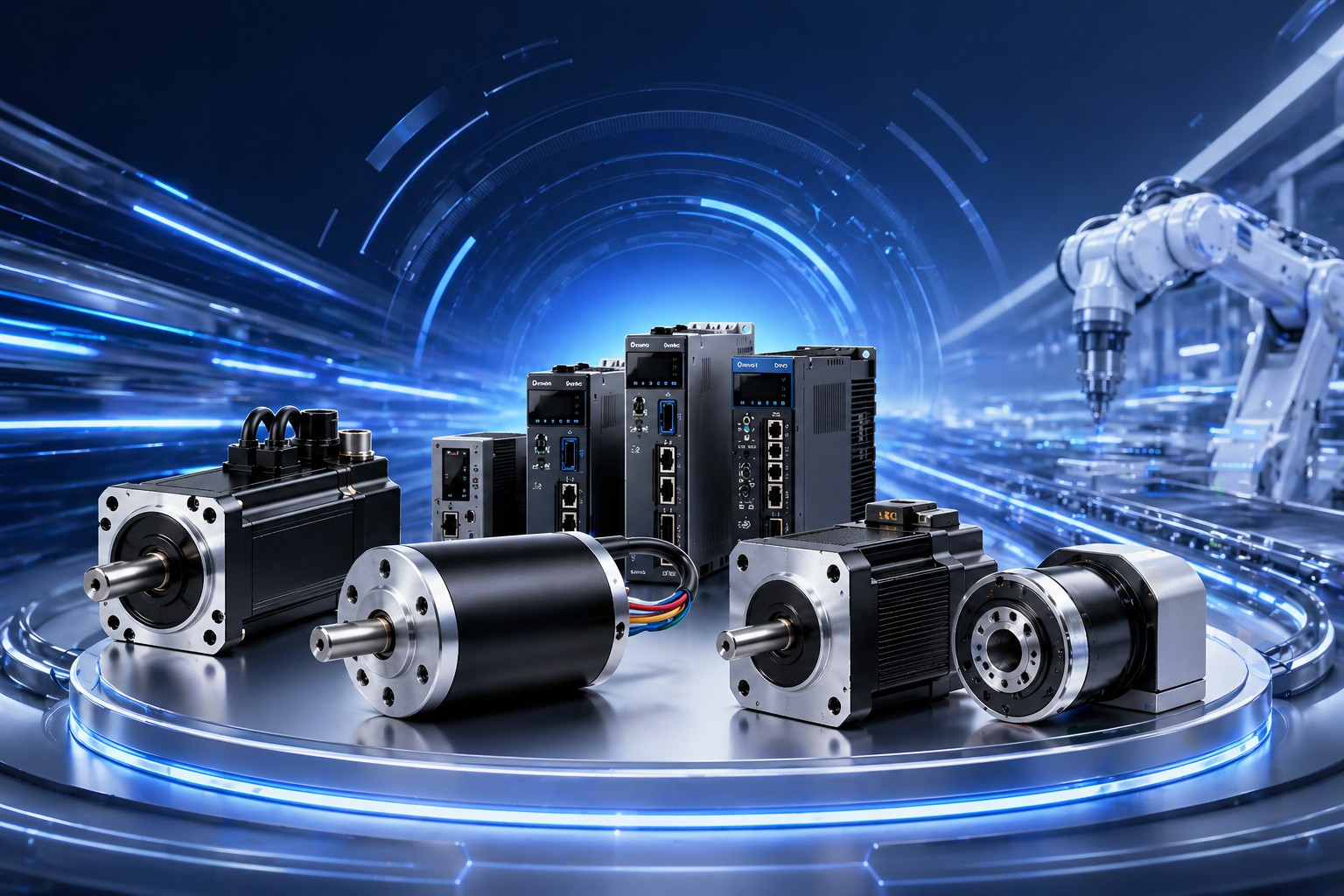
A BLDC gear motor combines a brushless DC motor with a mechanical gearbox so that OEM equipment can get the speed, torque, lifetime, and control behavior it needs without oversizing the motor. For engineers comparing planetary, spur, and worm gearboxes, the right choice depends on duty cycle, output speed, radial load, noise limits, efficiency targets, installation space, and how the motor will be controlled.
This guide explains how to select a brushless DC gear motor for industrial automation, logistics equipment, medical devices, access systems, commercial equipment, and compact robotic mechanisms. It also shows when to pair the motor with a BLDC motor driver, encoder, brake, or custom mounting design.
What Is a BLDC Gear Motor?
A BLDC gear motor is a brushless DC motor integrated with a gearbox. The BLDC motor provides electronic commutation, high efficiency, long service life, and stable speed control. The gearbox reduces output speed while increasing usable torque at the shaft. This makes the assembly useful in applications where a direct-drive motor would need to be larger, slower, or less efficient.
Compared with brushed gear motors, BLDC gear motors have no brushes to wear down. That helps reduce maintenance and makes them suitable for equipment that must run for long periods with stable performance. Compared with a standalone BLDC motor, a geared BLDC motor can deliver higher output torque at lower speed while staying compact.
If you are still comparing basic motor types, start with ZGC’s overview of what a BLDC motor is, then use this guide to narrow the gearbox choice.
When a BLDC Gear Motor Is the Right Choice
A BLDC gear motor is usually a strong fit when the application needs controlled motion, long life, compact torque density, and predictable speed. Common use cases include conveyor modules, AGV subsystems, gate systems, sorting mechanisms, medical pumps, commercial appliances, automated doors, packaging equipment, and compact lifting or rotating axes.
It is especially useful when the equipment needs one or more of the following:
- Low to medium output speed with higher torque than a direct BLDC motor can provide.
- Long operating life with lower maintenance than brushed motor solutions.
- Stable speed regulation through a BLDC motor controller.
- Compact mechanical integration with a gearbox, encoder, or brake.
- Custom output shaft, mounting flange, cable, connector, voltage, or control interface.
ZGC supplies BLDC gear motor options for OEM projects that need standard models or customized motor-drive assemblies.
Planetary BLDC Gear Motor: High Torque Density and Precision
A planetary BLDC gear motor is often the first choice for automation projects that need compact size, strong torque, and better output stability. Planetary gearboxes distribute load across multiple planet gears, which helps improve torque capacity and reduce backlash compared with many simple gearbox layouts.
Typical use cases include robot joints, precision conveyor modules, medical equipment, compact actuators, and equipment where the motor must fit in a narrow mechanical envelope. Planetary gearboxes can also be a good fit when the motor needs to handle frequent starts, stops, and direction changes.
Choose a planetary BLDC gear motor when your priority is compact torque, positioning repeatability, and a robust mechanical package. Check backlash, rated torque, radial load, and thermal limits early in the design process.
Spur BLDC Gear Motor: Simple, Efficient, and Cost Effective
A spur BLDC gear motor is a practical choice when the design needs moderate torque, good efficiency, and a straightforward mechanical structure. Spur gearboxes are commonly used in equipment where cost, manufacturability, and predictable output speed are more important than the highest torque density or lowest backlash.
Typical applications include commercial appliances, light-duty automation, rotating platforms, packaging mechanisms, and compact equipment modules. Spur gearboxes are easier to integrate in many designs, but they may create more gear noise than planetary gearboxes depending on speed, load, and housing design.
Choose a spur BLDC gear motor when you need a reliable, efficient, and economical geared motor for moderate load conditions.
Worm BLDC Geared Motor: Right-Angle Output and Holding Behavior
A worm BLDC geared motor is useful when the equipment needs right-angle output or a compact layout where the motor cannot align directly with the driven mechanism. Worm gearboxes can provide high reduction ratios in a small package, which makes them useful for access systems, small lifting mechanisms, valve control, gate systems, and compact rotary actuators.
Worm gearboxes can also provide stronger resistance to back-driving than many other gear structures, depending on the ratio and mechanical design. However, they are usually less efficient than planetary or spur gearboxes, so heat rise and duty cycle should be reviewed carefully.
Choose a worm BLDC geared motor when layout, reduction ratio, and holding behavior matter more than maximum gearbox efficiency.
How to Size a BLDC Gear Motor
The most common mistake is selecting only by rated power. A better approach is to calculate the actual load, speed, duty cycle, and operating environment before choosing the motor and gearbox.
1. Define output speed
Start with the required output shaft speed after the gearbox. If the driven mechanism needs 60 rpm, 120 rpm, or a controlled low-speed range, select a motor speed and gear ratio that keep the BLDC motor in an efficient operating zone.
2. Calculate continuous and peak torque
Separate continuous torque from peak torque. Conveyor motion, lifting, acceleration, and mechanical friction can create short peak loads that are much higher than steady-state torque. The gearbox and motor must survive those peaks without overheating or mechanical damage.
3. Check duty cycle and thermal behavior
A motor that works well for intermittent operation may overheat in continuous service. Review ambient temperature, enclosure ventilation, motor mounting, and expected run time. For enclosed OEM equipment, thermal margin is often more important than catalog power.
4. Match the gearbox to radial and axial loads
If the output shaft carries a belt pulley, wheel, gear, or lever arm, check radial and axial load limits. A gearbox can fail early if the shaft load is higher than the bearing structure allows, even when motor torque appears correct.
5. Choose the control method
A basic speed-control application may only need a compact BLDC driver. More demanding systems may need Hall feedback, encoder feedback, speed loop control, direction input, braking control, or communication with a PLC or main controller. ZGC offers BLDC motor driver options for different control requirements.
BLDC Gear Motor vs Stepper Gear Motor
A stepper gear motor is often selected for simple position indexing at lower cost. A BLDC gear motor is usually better when the application needs higher efficiency, smoother continuous rotation, lower heat generation at speed, and longer service life. For conveyor, fan, pump, sorting, and mobile equipment applications, BLDC gear motors often provide a better balance of speed control and durability.
If the project requires accurate position control, a BLDC gear motor can be paired with an encoder and suitable drive electronics. If the project only requires open-loop indexing and holding torque at standstill, a stepper solution may still be appropriate.
Customization Factors for OEM Projects
Most successful BLDC gear motor projects involve more than choosing a catalog part number. OEM equipment often needs mechanical, electrical, and control details adjusted around the final product design.
- Voltage: Match the motor winding and driver to the equipment power supply.
- Gear ratio: Balance output speed, torque, efficiency, and noise.
- Shaft design: Specify diameter, length, flat, keyway, thread, or custom output profile.
- Mounting: Confirm flange size, hole pattern, body length, and cable exit direction.
- Feedback: Add Hall sensors, magnetic encoders, or optical encoders where required.
- Brake: Add a brake for vertical load, safety holding, or stop-position stability.
- Connector and cable: Select wiring that fits assembly and service requirements.
- Environment: Consider dust, moisture, vibration, ambient temperature, and enclosure design.
For custom projects, share the target voltage, output speed, load torque, duty cycle, mounting constraints, expected annual quantity, and control method with the motor supplier. That gives the engineering team enough information to recommend a reliable design instead of simply matching a power rating.
Recommended Selection Path
- Start with the driven mechanism: output speed, load torque, duty cycle, and installation space.
- Choose the gearbox type: planetary for compact torque and precision, spur for efficient cost-effective motion, worm for right-angle layouts and high reduction.
- Confirm motor voltage, rated speed, and thermal margin.
- Select the BLDC driver and feedback method.
- Validate shaft load, mounting, cable direction, and environmental requirements.
- Prototype and test under real load before final production approval.
Why Work With ZGC Motors
ZGC Motors manufactures brushless DC motors, BLDC gear motors, stepper motors, servo motors, motor drivers, brakes, encoders, and customized motion-control assemblies. The engineering team supports standard and customized motor solutions for industrial automation, logistics systems, medical equipment, commercial equipment, and other OEM applications.
Explore ZGC’s BLDC gear motor category or contact the engineering team with your target speed, torque, voltage, gearbox type, and installation requirements.
FAQ
What is the difference between a BLDC motor and a BLDC gear motor?
A BLDC motor is the brushless motor itself. A BLDC gear motor combines that motor with a gearbox to reduce output speed and increase usable shaft torque.
Which gearbox is best for a BLDC gear motor?
Planetary gearboxes are usually best for compact torque and precision, spur gearboxes for efficient and economical motion, and worm gearboxes for right-angle output or high reduction in limited space.
Can a BLDC gear motor be used for speed control?
Yes. A BLDC gear motor can be paired with a suitable BLDC motor driver for speed control, direction control, and in some systems closed-loop feedback.
Can ZGC customize a BLDC gear motor?
Yes. ZGC can support custom voltage, gear ratio, shaft, mounting, cable, connector, feedback, brake, and driver requirements for OEM projects.
Related guide: If the BLDC gear motor must hold a vertical, indexed or safety-sensitive load, review the BLDC motor with brake and encoder selection guide before finalizing the gearbox and controller package.