1. Executive Summary
The electric motor industry stands at a pivotal transformation point. As global automation accelerates, the demand for precision motion control solutions has never been more critical. This white paper provides a comprehensive examination of modern motor technologies, including servo motors, brushless DC (BLDC) motors, stepper systems, and integrated motor-drive solutions that are reshaping industrial automation, robotics, and consumer electronics.
Drawing from two decades of manufacturing expertise and serving customers across 180+ countries, this document delivers actionable technical insights for engineers, OEMs, and system integrators seeking to optimize their motion control architectures. Each technology category is analyzed across performance parameters, application suitability, integration considerations, and emerging trends.
Key areas covered in this white paper include:
- Servo motor technologies and closed-loop control systems (servo motor drive & servo motor controller)
- Brushless DC (BLDC) motor variants including inner/outer rotor configurations and high-torque designs
- Stepper motor systems with closed-loop enhancements and NEMA frame standards
- Permanent Magnet Synchronous Motor (PMSM) and Field-Oriented Control (FOC) methodologies
- Gear motor solutions: planetary and brushed DC gear motor configurations
- Integrated motor drive systems and specialized applications (lawn mower, garden tools, waterproof)
- Custom servo motor design and ODM manufacturing capabilities
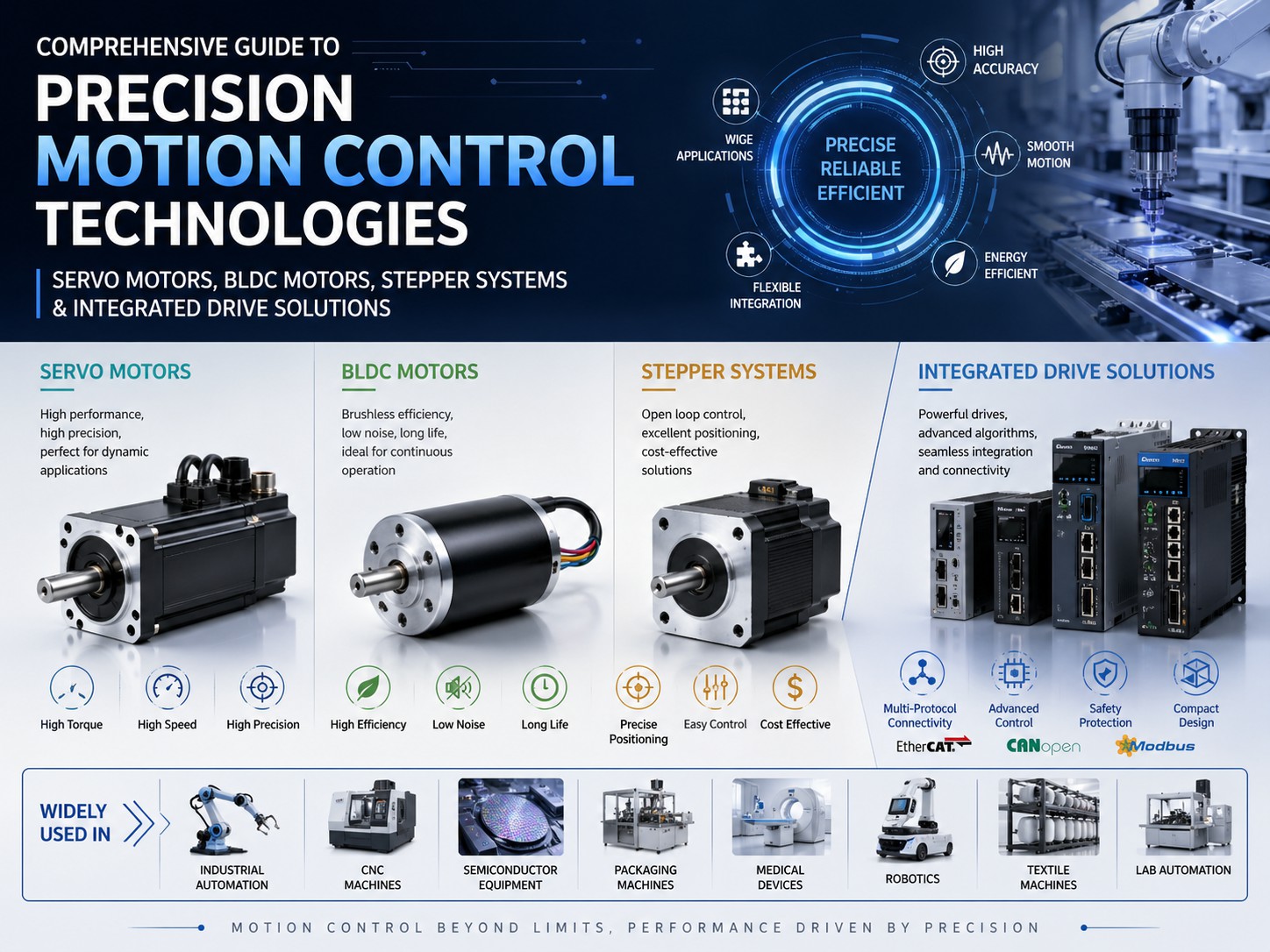
2. Industry Overview & Market Landscape
2.1 Global Market Dynamics
The precision motor market is experiencing unprecedented growth driven by Industry 4.0 initiatives, electric vehicle proliferation, robotics advancement, and smart home adoption. The convergence of these trends has created substantial demand for high-efficiency, compact, and intelligent motor solutions.
Key market drivers include:
- Industrial Automation: AGV systems, conveyor networks, automated sorting equipment require precise position control
- Robotics Expansion: Collaborative robots (cobots), articulated joint motors, and humanoid platforms demand high torque density
- Green Energy Transition: Electric lawn mowers, garden tools, and outdoor power equipment shifting from combustion to BLDC power
- Medical Equipment: Surgical robots, diagnostic instruments, and patient handling devices need ultra-quiet, smooth operation
- Consumer Electronics: Smart appliances, HVAC systems, and home automation increasingly embed precision motors
2.2 Technology Convergence Trends
Modern motor systems are no longer isolated components. The industry is witnessing significant convergence between motor hardware and embedded intelligence. Key trends include:
- Integration: Combined motor + driver in single housing reduces wiring complexity and EMI issues
- Connectivity: Modbus, CANopen, and EtherCAT protocols enabling real-time networked control
- Intelligence: Built-in diagnostics, auto-tuning algorithms, and predictive maintenance capabilities
- Efficiency: FOC (Field Oriented Control) becoming standard for achieving maximum torque-per-ampere performance
3. Servo Motor Technology Deep Dive
3.1 Servo Motor Fundamentals
A servo motor is a rotary actuator or linear actuator that enables precise control of angular or linear position, velocity, and acceleration. It consists of a suitable motor coupled to a sensor for position feedback. The servo motor system comprises three essential components: the motor itself, a feedback device (typically an encoder or resolver), and the servo motor controller/driver that closes the control loop.
Unlike open-loop systems, servo motors continuously monitor actual output through encoder feedback, comparing it against commanded values and making real-time corrections. This closed-loop architecture delivers positioning accuracy measured in arc-minutes or even arc-seconds, far exceeding what stepper motors can achieve without similar feedback mechanisms.
| Parameter | Standard Servo | High-Performance Servo |
| Position Accuracy | ±0.01° to ±0.001° | ±0.0001° or better |
| Speed Range | 1-3000 RPM typical | Up to 6000+ RPM |
| Torque Ripple | < 5% rated torque | < 2% rated torque |
| Encoder Resolution | 17-bit (131,072 ppr) | 23-bit+ (8M+ ppr) |
| Control Modes | Position/Speed/Torque | Position/Speed/Torque + Advanced |
| Frame Sizes | 40mm, 60mm, 80mm, 130mm | Custom sizes available |
3.2 Servo Motor Drive & Controller Architecture
The servo motor drive (also called servo amplifier or servo controller) serves as the command center of any servo system. It receives motion commands from a PLC, CNC controller, or motion controller, then generates precisely timed PWM signals to drive the motor windings while simultaneously processing encoder feedback to maintain closed-loop control.
Modern servo motor controllers implement sophisticated control algorithms:
- PID Control Loop: Proportional-Integral-Derivative tuning for optimal response characteristics
- Feedforward Compensation: Predictive control reducing following errors during dynamic motion
- Notch Filtering: Resonance suppression for systems with mechanical compliance
- Auto-Tuning: Automated parameter identification and gain scheduling
- Gantry Synchronization: Cross-coupled control for multi-axis coordination
3.3 Specialized Servo Motor Variants
3.3.1 BLDC Servo Motor
BLDC servo motors combine the benefits of brushless construction (no commutator wear, lower EMI, higher efficiency) with servo-grade precision. These motors utilize permanent magnet rotors with trapezoidal or sinusoidal back-EMF profiles and are driven by electronic commutation via Hall sensors or sensorless algorithms. BLDC servo motors offer excellent dynamic response, high power density, and extended operational life compared to brushed alternatives.
3.3.2 Stepper Servo Motor (Closed-Loop Stepper)
Stepper servo motors represent a hybrid approach merging stepper motor simplicity with servo system accuracy. By adding an encoder to a traditional stepper motor and implementing closed-loop control in the drive, these systems eliminate step-loss problems entirely while maintaining cost advantages over full servo systems. They excel in applications requiring moderate precision at competitive price points, particularly in the 100-500W power range.
3.3.3 Motor with Encoder
Encoder integration is fundamental to all servo systems. Encoder types include incremental optical encoders, absolute multi-turn encoders using battery backup or gear-based mechanical counting, and magnetic encoders offering shock resistance. Selection criteria encompass resolution requirements (affecting positioning accuracy and velocity smoothness), environmental conditions (dust, moisture, vibration tolerance), interface compatibility (TTL, HTL, differential, SSI, BiSS-C, Endat), and total cost of ownership.
3.3.4 Joint Motor
Joint motors (articulated robot joint actuators) represent specialized servo motor assemblies designed specifically for robotic arm joints. These units feature extremely high torque-to-weight ratios, often incorporate harmonic drives or strain wave gears directly into the motor assembly, provide absolute position feedback for immediate homing upon power-up, and may integrate brakes, sensors, and sometimes even the drive electronics into a single compact package. Joint motors enable the next generation of collaborative robots and service robotics.
3.3.5 Custom Servo Motor
Off-the-shelf servo motors cannot address every application requirement. Custom servo motor development addresses unique specifications including non-standard form factors for space-constrained installations, specialized winding patterns optimizing specific torque-speed curves, environmental hardening for extreme temperature, vacuum, radiation, or submersion conditions, application-specific shaft designs, mounting interfaces, and connector configurations, as well as integrated custom gearing, brakes, clutches, or other mechanical features. Leading manufacturers like ZGC Motors offer comprehensive ODM services from concept validation through mass production.
4. Brushless DC (BLDC) Motor Technology
4.1 BLDC Motor Fundamentals
Brushless DC motors (BLDC motors / brushless motors) have become the dominant choice for applications demanding high efficiency, long lifespan, low electromagnetic interference, and superior controllability. Unlike their brushed counterparts, BLDC motors eliminate physical commutator brushes by electronically switching current through the stator windings based on rotor position feedback from Hall-effect sensors or back-EMF sensing algorithms.
The terminology landscape includes several interchangeable terms: BLDC motor, bldc motor, and brushless motor all refer to the same fundamental technology. Understanding the nuances between different BLDC configurations is critical for proper motor selection.
4.2 Rotor Configuration Comparison
4.2.1 Inner Rotor BLDC Motor
In inner rotor BLDC motor configurations, permanent magnets are attached to a central rotating shaft while stator windings surround the rotor externally. This design provides excellent heat dissipation since the stationary stator can be directly cooled, achieves higher RPM capability due to lower rotor inertia, delivers higher power density per unit volume, and suits applications prioritizing speed and dynamic response. Typical applications include power tools, drones, fans, and high-speed spindles.
4.2.2 Outer Rotor BLDC Motor
Outer rotor BLDC motors invert the conventional arrangement: the rotor (with permanent magnets) rotates around a stationary internal stator. This configuration yields higher torque output at lower speeds due to larger moment arm, offers natural flywheel effect improving rotational stability, simplifies direct-drive fan and wheel hub applications, and typically operates more quietly due to larger air gap surface area smoothing cogging torque. Common applications include computer cooling fans, drone propulsion, electric vehicle hub motors, and ceiling fans.
| Characteristic | Inner Rotor | Outer Rotor |
| Torque Output | Lower torque, higher speed | Higher torque, lower speed |
| Heat Dissipation | Excellent (stator exposed) | Good (rotor acts as heatsink) |
| Speed Capability | Very high (>10,000 RPM) | Moderate (<5,000 RPM) |
| Inertia | Low inertia, fast accel | High inertia, stable speed |
| Typical Applications | Power tools, spindles, pumps | Fans, hubs, direct-drive wheels |
4.3 High Torque BLDC Motor Design
High torque BLDC motors are engineered to maximize torque production within constrained envelope dimensions. Design techniques include concentrated winding layouts increasing slot fill factor and copper utilization, multi-pole magnet arrangements maximizing flux linkage, advanced rare-earth magnet materials (NdFeB grades N48-N52) delivering stronger magnetic fields, optimized pole-slot combinations minimizing detent and cogging torque, and thermal management strategies allowing sustained high-current operation. Applications span AGV traction drives, robotic joints, electric vehicle auxiliary systems, and industrial machinery requiring substantial continuous torque.
4.4 Waterproof BLDC Motor
Waterproof BLDC motors are engineered for operation in wet, humid, or submerged environments where standard motors would fail. Protection ratings range from IP54 (splash-resistant dust protection) through IP65 (jet water protection) to IP67/IP68 (temporary/permanent submersion). Sealing techniques involve epoxy potting of stator windings, specialized shaft seals (lip seals, mechanical face seals), hermetically sealed connectors or molded cable entries, corrosion-resistant housings (stainless steel, marine-grade aluminum), and conformal coating of PCBs inside integrated drives. Primary applications include marine equipment, food processing machinery, outdoor power equipment, pool/spa systems, and agricultural irrigation.
4.5 Application-Specific BLDC Solutions
4.5.1 Lawn Mower Motor
The transition from gasoline-powered to electric lawn mowers represents one of the most significant market shifts for BLDC motors in recent years. Electric mower motors must deliver high startup torque for cutting through dense grass, sustain operation under variable loads (tall grass, damp conditions), operate efficiently to maximize battery runtime, withstand debris ingress (grass clippings, dirt, moisture), and meet stringent acoustic noise regulations. Modern designs favor high-torque BLDC motors paired with optimized blade geometries and electronic controllers implementing soft-start, overload protection, and regenerative braking functions.
4.5.2 Brushless Motor for Garden Tools
Beyond lawn mowers, the broader category of cordless garden tools has embraced BLDC motor technology. Hedge trimmers, string trimmers, leaf blowers, chainsaws, tillers, and cultivators all benefit from the high energy efficiency extending battery runtime, reduced weight compared to equivalent brushed motors, instant torque delivery eliminating pull-start frustration, lower maintenance (no brush replacement), and quieter operation improving user experience and neighborhood relations. Market leaders have developed platform motor families scaling across multiple tool products, achieving economies of scale while meeting each tool’s unique torque-speed requirements through gearing variations.
5. BLDC Motor Controller & Driver Technology
5.1 Control Methodologies
BLDC motor controllers (also referred to as BLDC motor drivers, BLDC motor drives, brushless motor drives, or simply brushless motor drivers) convert DC power into appropriately sequenced three-phase AC waveforms to rotate the motor. Three primary control methods dominate the field:
5.1.1 Trapezoidal (Six-Step) Commutation
The simplest and most cost-effective approach, trapezoidal commutation energizes two motor phases at a time based on Hall sensor signals. While straightforward to implement, this method produces audible torque ripple at each commutation point and limits smoothness during low-speed operation. Suitable for basic fan/pump applications where cost sensitivity outweighs refinement requirements.
5.1.2 Sinusoidal Commutation
Sinusoidal control generates smooth sinusoidal currents in all three phases simultaneously, producing significantly smoother rotation with minimal torque ripple. Requires either high-resolution position feedback (encoder or resolver) or sophisticated sensorless algorithms estimating rotor angle from back-EMF waveforms. Preferred for precision motion, audio-sensitive applications, and scenarios demanding premium acoustic performance.
5.1.3 Field-Oriented Control (FOC) — foc_motor_drive
Field-Oriented Control represents the state-of-the-art in BLDC motor control. By mathematically transforming three-phase AC quantities into a rotating d-q reference frame aligned with the rotor flux, FOC decouples torque-producing and flux-producing current components, enabling independent optimization of each. Benefits include maximum torque-per-ampere (MTPA) operation, precise torque control down to zero speed, efficient field weakening for constant-power operation above base speed, seamless transition between motoring and regeneration modes, and excellent dynamic response. FOC implementations support both PMSM (Permanent Magnet Synchronous Motor) and BLDC motor topologies, making foc_motor_drive the preferred solution for demanding applications ranging from electric vehicles to industrial servos.
5.2 PMSM Motor Technology
Permanent Magnet Synchronous Motors (PMSM motors) share fundamental operating principles with BLDC motors but differ critically in back-EMF waveform shape and corresponding control strategy. PMSM motors produce sinusoidal back-EMF (versus trapezoidal in conventional BLDC), requiring continuous sinusoidal current excitation rather than discrete six-step commutation. This yields smoother torque output, lower acoustic noise, and higher peak efficiency. PMSM motors are the default choice for electric vehicle traction, high-end servo applications, and any system where acoustic refinement and efficiency are paramount.
5.3 Communication Interfaces
Modern BLDC/servo motor controllers offer multiple communication options for integration into larger automation ecosystems:
| Protocol | Data Rate | Topology | Best For |
| Modbus RTU | up to 115.2 kbps | RS-485 multidrop | Simple monitoring/control |
| CANopen | 1 Mbps | Bus topology | Industrial automation, multi-axis |
| EtherCAT | 100 Mbps+ | Ring/daisy-chain | High-performance motion sync |
| UART/SPI/I2C | Varies | Point-to-point | Embedded/integrated systems |
6. Stepper Motor Technology
6.1 Stepper Motor Fundamentals
Stepper motors divide each full rotation into a fixed number of discrete steps, enabling precise open-loop position control without requiring feedback devices. By energizing coil windings in a predetermined sequence, the rotor advances incrementally one step at a time. Standard step angles include 1.8° (200 steps/revolution, most common), 0.9° (400 steps/revolution, half-step compatible), and 1.2° (300 steps/revolution). Microstepping techniques further subdivide each full step into smaller increments (commonly 1/16, 1/32, 1/64, up to 1/256 microstep resolution) producing smoother rotation at the expense of reduced holding torque.
6.2 NEMA Stepper Motor Frame Standards
NEMA (National Electrical Manufacturers Association) frame sizes define standardized mounting dimensions ensuring interchangeability between manufacturers. Common NEMA stepper motor sizes range from NEMA 8 (20mm square, ~0.5W) through NEMA 34 (86mm square, ~12W) and beyond for heavy-duty industrial applications.
| NEMA Size | Face (mm) | Torque Range | Typical Power | Common Uses |
| NEMA 8 | 20×20 | 0.01-0.05 Nm | < 2W | Medical, optics |
| NEMA 11 | 28(28 | 0.03-0.12 Nm | 2-5 W | Lab equipment, 3D printers |
| NEMA 14 | 35×35 | 0.08-0.25 Nm | 5-10 W | Small CNC, engraving |
| NEMA 17 | 42×42 | 0.25-0.65 Nm | 10-25 W | 3D printers, laser cutters |
| NEMA 23 | 57×57 | 0.45-2.0 Nm | 25-75 W | CNC routers, textile machines |
| NEMA 34 | 86×86 | 2.0-8.0 Nm | 75-200 W | Large CNC, plasma cutters |
6.3 Closed Loop Stepper Motor
Traditional open-loop steppers suffer from inherent limitations: they can lose synchronism (“stall”) under excessive load or acceleration, require generous torque margins (often 50%+) to prevent missed steps, waste energy holding static position at full current, and generate significant acoustic noise during operation. Closed loop stepper motor technology resolves these deficiencies by incorporating encoder feedback into the stepper control loop.
Benefits of closed-loop stepper systems include:
- Zero stall risk: controller detects and corrects any positional error in real-time
- Higher usable torque: safely operate closer to actual motor capacity rather than conservative estimates
- Energy savings: reduce holding current when load demand is minimal
- Quieter operation: smoother current profiles reduce acoustic emissions
- Cost-effective precision: achieve near-servo accuracy at significantly lower system cost
7. Gear Motor Solutions
7.1 Planetary Gear Motor
Planetary gear motors (planetary gear motor) combine high-precision planetary reduction stages with electric motors to deliver exceptional torque multiplication within compact envelopes. A planetary gearset consists of a central sun gear meshing with multiple planet gears (typically 3-4) that simultaneously engage an outer ring gear. Multiple planet teeth sharing the load distributes stress evenly, enabling high torque capacity relative to size and weight.
Key advantages of planetary gear motors:
- High torque density: multiple planets distribute load efficiently
- Excellent backlash specification: precision versions achieve < 5 arc-min backlash
- High efficiency: single stage 97%, double stage 94%, triple stage 91% typical
- Compact coaxial design: input and output share same axis, simplifying machine layout
- Multiple reduction stages: easily stacked for ratios from 3:1 to 1000:1+
BLDC gear motor variants pair BLDC motors with planetary gearheads, combining the efficiency and longevity benefits of brushless construction with the mechanical advantage of planetary reduction. These assemblies find extensive use in AGV steering actuators, robotic joints, conveyor tensioning systems, valve actuators, and precision positioning tables.
7.2 Brushed DC Gear Motor
Brushed DC gear motors remain relevant for cost-sensitive applications where the total lifecycle cost favors lower initial investment over extended maintenance-free operation. Brushed DC motors use carbon/graphite brushes mechanically contacting a rotating commutator to switch current direction in the rotor windings. When combined with spur or planetary gear reductions, these motors provide economical solutions across numerous product categories.
Applications of brushed DC gear motors span:
- Consumer appliances: coffee makers, blender bases, automatic soap dispensers
- Automotive accessories: seat adjusters, window lifters, mirror actuators
- Toys and hobby models: radio-controlled vehicles, action figures, educational kits
- Office equipment: paper feed mechanisms, shredder drums, projector focus/zoom
- Medical disposables: infusion pump heads, centrifuge drives, analyzer sample handlers
While brushed motors incur periodic brush replacement (typically every 2,000-10,000 hours depending on duty cycle and load), their simplicity, low cost, and ease of speed control via simple voltage adjustment ensure continued relevance in appropriate applications.
8. Integrated Motor Drive Systems
8.1 Concept and Advantages
Integrated motor drive systems (integrated motor drive) combine motor, feedback device, drive electronics, and often communications interfaces into a single unified package. This architectural consolidation delivers compelling benefits for many applications:
- Reduced wiring complexity: eliminates shielded motor cables, encoder cables, and separate drive enclosures
- Improved EMI performance: high-current PWM switching occurs within shielded enclosure rather than radiating from long cables
- Simplified installation: single cable carrying power and communications replaces multiple cable runs
- Space savings: eliminates need for separate electrical cabinet space for drives
- Plug-and-play operation: factory-matched motor/drive combination ensures optimal tuning out-of-box
- Thermal synergy: motor housing serves as heatsink for drive electronics in some designs
8.2 Implementation Considerations
When evaluating integrated motor drives, consider the following factors:
- Power limitations: current integrated designs cap around 5-10 kW due to thermal constraints; larger systems still require separate drives
- Environmental rating: ensure IP rating matches installation environment (many integrated units achieve IP65 or better)
- Serviceability: assess whether failed units are repaired or replaced entire assembly
- Communication protocol: verify compatibility with existing automation network infrastructure
- Software ecosystem: evaluate configuration, tuning, and diagnostic tooling quality
9. Application Domains & Use Cases
9.1 Industrial Automation
Industrial automation remains the largest consumer of precision motor technologies. Manufacturing facilities deploy servo-driven CNC machines for metal cutting, forming, and additive manufacturing; stepper-powered pick-and-place machines for electronics assembly; BLDC-driven conveyor systems for material handling; and AGV fleets utilizing integrated drive systems for autonomous logistics. The trend toward flexible manufacturing (mass customization, batch-size-one economics) demands ever-more-adaptable motion systems capable of rapid reconfiguration.
9.2 Warehouse & Logistics
Modern fulfillment centers rely heavily on precision motor systems. Automated guided vehicles (AGVs) and autonomous mobile robots (AMRs) navigate warehouse floors using BLDC traction drives and servo-steered axles. High-speed sortation systems employ servo-controlled divert mechanisms routing packages at rates exceeding 100 pieces per minute. Conveyor networks utilize synchronized BLDC and servo drives maintaining throughput consistency across miles of material handling infrastructure.
9.3 Robotics & Cobots
The robotics sector represents the fastest-growing segment for precision motors, particularly joint motors and custom servo motor assemblies. Collaborative robots (cobots) designed for safe human interaction require high torque density, built-in compliance sensing, and absolute position feedback enabling immediate restart after power loss. Service robots (vacuum cleaners, lawn mowers, inspection drones) leverage waterproof BLDC motors and brushless motor for garden tools technology. Industrial robot arms continue pushing toward higher payload-to-weight ratios enabled by advances in direct-drive and quasi-direct-drive joint motor designs.
9.4 Agricultural Equipment
Agricultural automation increasingly incorporates precision motor technology. Autonomous tractors and implements utilize robust, sealed motors capable of withstanding dust, moisture, temperature extremes, and prolonged vibration exposure. Livestock management equipment (automated feeding, milking, grooming) requires quiet operation avoiding animal stress. Greenhouse automation (ventilation, irrigation, shading, lighting) benefits from efficient, long-life BLDC motors reducing energy costs in continuous-operation scenarios.
9.5 Medical & Healthcare
Medical equipment places extreme demands on motor performance: surgical robots demand sub-millimeter positioning repeatability; imaging devices require ultra-smooth rotation eliminating image artifacts; patient-handling equipment must operate silently and reliably; portable devices prioritize weight and battery life. Medical-grade motors undergo enhanced quality controls, use biocompatible materials where applicable, and must maintain performance over years of intermittent operation with minimal preventive maintenance.
9.6 Home & Commercial Appliances
The appliance sector consumes vast quantities of motors spanning all technology categories. Premium HVAC systems employ variable-speed BLDC compressors and fan motors achieving SEER ratings exceeding 25. Smart kitchen appliances (stand mixers, blenders, food processors) utilize programmable BLDC motors with preset speed profiles. Automatic window blinds, garage door openers, and projection screens depend on quiet, reliable geared motors. Commercial applications including vending machines, elevators, and HVAC chillers specify industrial-grade reliability with consumer-friendly acoustics.
10. Manufacturing Excellence & Quality Assurance
10.1 Production Capabilities
Leading precision motor manufacturers such as ZGC Motors bring decades of accumulated expertise to motor design and production. With 20+ years of industry experience, operations spanning 180+ countries (with 55% of business in Europe), and a team of 100+ professionals covering engineering, manufacturing, quality assurance, and customer support, world-class manufacturers deliver consistent quality at scale.
Core manufacturing capabilities include:
- Complete in-house motor design from concept through production drawings and prototyping
- Precision CNC machining of motor housings, shafts, and end bells
- Automated stator winding with controlled tension and layer placement
- Magnetization and rotor balancing to ISO 1940 balance grade standards
- Assembly lines with integrated testing stations performing 100% functional verification
- Cleanroom environments for medical-grade and high-purity applications
10.2 Quality Standards & Certifications
Rigorous quality control processes ensure every shipped motor meets or exceeds specifications. Products undergo comprehensive testing protocols including dimensional verification, electrical parameter measurement (resistance, inductance, back-EMF constant), insulation resistance and dielectric strength testing, no-load and loaded performance characterization, acoustic noise measurement, thermal cycling and endurance testing, and vibration analysis.
International certifications maintained include CE marking (European conformity), RoHS compliance (restriction of hazardous substances), UL listing (Underwriters Laboratories safety certification), and ISO 9001:2015 quality management systems. Top-tier manufacturers maintain annual defective rates below 0.5%, reflecting commitment to zero-defect manufacturing philosophy.
10.3 Custom Development (ODM) Services
Many applications require purpose-designed motors not available from standard catalogs. Comprehensive ODM (Original Design Manufacturer) services guide customers through the entire development journey: requirements analysis and specification development, conceptual design with multiple architecture options, prototyping and iterative validation testing, design-for-manufacturing (DFM) optimization, pilot production and first-article inspection, volume ramp-up with progressive quality gates, and ongoing lifecycle management including obsolescence planning. Whether adapting an existing motor design or developing something entirely novel, experienced ODM partners accelerate time-to-market while managing technical risk.
11. Motor Selection Guidelines
Choosing the optimal motor technology for a given application requires systematic evaluation across multiple dimensions. The following decision framework guides engineers toward appropriate selections:
| If your priority is… | Consider… | Example Applications |
| Maximum precision & dynamics | Servo motor + servo motor drive | CNC machining, semiconductor handling |
| Efficiency & longevity | BLDC motor / brushless motor | Drones, fans, EV auxiliaries |
| Cost-effective positioning | Stepper / NEMA stepper motor | 3D printers, label printers, CCTV |
| Open-loop reliability | Closed loop stepper motor | Medical pumps, lab automation |
| High torque, low speed | Planetary gear motor / BLDC gear motor | AGV wheels, robot joints, conveyors |
| Lowest initial cost | Brushed DC gear motor | Consumer appliances, toys, autos |
| Simplified integration | Integrated motor drive | Compact machinery, distributed I/O |
| Outdoor/wet environment | Waterproof BLDC motor | Marine, pools, garden tools |
| Unique requirements | Custom servo motor (ODM) | Specialty OEM, defense, aerospace |
12. Future Outlook & Emerging Trends
12.1 Technology Trajectories
Several technology vectors will shape the precision motor landscape over the coming years:
- Wide-bandgap semiconductors: Silicon carbide (SiC) and gallium nitride (GaN) power devices enable higher switching frequencies, reduced losses, and smaller passive component sizing in motor drives, yielding more compact, efficient integrated systems.
- AI-enhanced control: Machine learning algorithms for adaptive motor tuning, predictive fault detection, and optimized trajectory planning will become embedded features in commercial drives.
- Additive manufacturing: 3D-printed motor components (windings via wire-arc AM, laminations via binder jetting) unlock previously impossible geometries optimizing electromagnetic performance.
- Sustainable materials: Reduced reliance on rare-earth elements through ferrite magnet improvements, recycled material programs, and end-of-life motor recycling initiatives.
- Digital twins: Virtual motor models enabling simulation-driven design, commissioning, and predictive maintenance throughout product lifecycle.
12.2 Market Growth Projections
Analyst consensus projects continued strong growth across all precision motor categories through 2030. Electric mobility (both automotive and micromobility) drives BLDC motor demand. Factory automation investments accelerate servo and stepper consumption. The electrification of outdoor power equipment (lawn mowers, chainsaws, etc.) creates rapidly expanding addressable markets for high-torque BLDC motors and waterproof BLDC motor designs. Robotics proliferation across industrial, service, and consumer segments fuels demand for joint motors, custom servo motors, and integrated motor drive packages.
13. Conclusion
The precision motor industry offers an exceptionally diverse portfolio of technologies addressing virtually every motion control challenge imaginable. From the elegant simplicity of open-loop stepper motors driving 3D printers to the sophistication of FOC-controlled PMSM servos powering aerospace actuators, the right technology selection depends on careful matching of application requirements against available options.
This white paper has examined the complete spectrum of modern motor technologies:
- Servo motor systems including servo motor drive and servo motor controller architectures for highest-precision applications
- BLDC motor variants spanning inner rotor bldc motor, outer rotor bldc motor, and high torque bldc motor configurations
- Brushless motor controller and BLDC motor driver technologies including FOC motor drive methodology for PMSM motor control
- Stepper motor fundamentals, NEMA stepper motor frame standards, and closed loop stepper motor enhancements
- Planetary gear motor and BLDC gear motor assemblies alongside traditional Brushed DC gear motor options
- Integrated motor drive systems consolidating motor and electronics into unified packages
- Application-specific solutions including lawn mower motor, waterproof bldc motor, and brushless motor for garden tools
- Custom servo motor development capabilities for unique or demanding applications
For organizations navigating these choices, partnering with an experienced manufacturer offering both standard catalog products and comprehensive ODM capabilities provides maximum flexibility. With rigorous quality control, global certifications, responsive technical support, and proven track records serving customers worldwide, established manufacturers stand ready to support your motion control success.
We invite you to explore how our motor solutions can enhance your products and systems. Visit us at www.zgcmotors.com or contact our engineering team to discuss your specific requirements.
Appendix A: Keyword Reference Index
This white paper covers the following key motor technology terms, which correspond to primary search and classification keywords in the precision motor industry:
| Keyword | Primary Coverage Section |
| servo motor | Section 3: Servo Motor Technology Deep Dive |
| servo motor drive | Section 3.2: Servo Motor Drive & Controller Architecture |
| servo motor controller | Section 3.2: Servo Motor Drive & Controller Architecture |
| bldc servo motor | Section 3.3.1: BLDC Servo Motor |
| stepper servo motor | Section 3.3.2: Stepper Servo Motor (Closed-Loop Stepper) |
| motor with encoder | Section 3.3.3: Motor with Encoder |
| joint motor | Section 3.3.4: Joint Motor |
| brushless dc motor | Section 4: Brushless DC (BLDC) Motor Technology |
| bldc motor / brushless motor | Section 4: Brushless DC (BLDC) Motor Technology |
| outer rotor bldc motor | Section 4.2.2: Outer Rotor BLDC Motor |
| inner rotor bldc motor | Section 4.2.1: Inner Rotor BLDC Motor |
| high torque bldc motor | Section 4.3: High Torque BLDC Motor Design |
| brushless motor kit | Sections 4-5: BLDC Motor + Controller Integration |
| bldc motor controller | Section 5: BLDC Motor Controller & Driver Technology |
| BLDC motor driver | Section 5: BLDC Motor Controller & Driver Technology |
| brushless motor drive | Section 5: BLDC Motor Controller & Driver Technology |
| stepper motor | Section 6: Stepper Motor Technology |
| closed loop stepper motor | Section 6.3: Closed Loop Stepper Motor |
| nema stepper motor | Section 6.2: NEMA Stepper Motor Frame Standards |
| PMSM motor | Section 5.2: PMSM Motor Technology |
| foc motor drive | Section 5.1.3: Field-Oriented Control (FOC) |
| planetary gear motor | Section 7.1: Planetary Gear Motor |
| bldc gear motor | Section 7.1: Planetary Gear Motor |
| Brushed DC gear motor | Section 7.2: Brushed DC Gear Motor |
| integrated motor drive | Section 8: Integrated Motor Drive Systems |
| lawn mower motor | Section 4.5.1: Lawn Mower Motor |
| waterproof bldc motor | Section 4.4: Waterproof BLDC Motor |
| brushless motor for garden tools | Section 4.5.2: Brushless Motor for Garden Tools |
| custom servo motor | Section 3.3.5: Custom Servo Motor / Section 10.3: ODM |
About ZGC Motors
Changzhou ZGC Mechanical & Electrical Co., Ltd. (ZGC Motors) is a professional company integrating research and development, manufacturing, sales, and service of precision DC motors and motor drive solutions. With over 20 years of industry expertise, ZGC Motors serves customers in more than 180 countries worldwide, with 55% of business concentrated in Europe.
Our product portfolio encompasses:
- Servo Motors (40mm, 60mm, 80mm, 130mm frame sizes) with closed-loop position/speed/torque control
- Brushless DC Motors (22-78mm diameter) available with planetary or spur gearbox options
- Stepping Motors (20-86mm) featuring 0.9°/1.2°/1.8° step angles and optional IP65 waterproofing
- Joint Motors delivering high torque with instant response in compact form factors
- Motor Drives supporting Modbus, CANopen, and EtherCAT communication protocols
- Solenoids (bistable rotation series) for specialized actuation needs
- Brushed Gear Motors with encoder options for cost-sensitive applications
- Custom/OEM motor development services tailored to unique specifications
All products comply with CE, RoHS, and UL international standards. Our rigorous quality control processes maintain annual defective rates below 0.5%. We provide comprehensive technical support, collaborative design partnerships, and responsive customer service to ensure project success.
www.zgcmotors.com | zgc@cz-zgc.com
Integrated motor option: For distributed motion axes and compact OEM modules, compare separate drives with an integrated BLDC motor with driver.