Introduction: The Critical Role of Servo Motors in Modern Robotics
In today’s rapidly evolving industrial automation landscape, selecting the appropriate servo motor for robotic applications is not merely a technical decision—it’s a strategic one. The right motor can mean the difference between a robotic system that operates with precision, reliability, and efficiency, and one that suffers from frequent downtime, positioning errors, and premature failure.
1. Understanding Robotic Motion Requirements
1.1 Payload Capacity and Torque Demands
Industrial robots typically handle varying payloads across different applications. When selecting a servo motor, consider:
- Maximum payload weight and its distribution
- Acceleration requirements for dynamic movements
- Continuous vs. peak torque demands
1.2 Speed and Precision Requirements
Different robotic applications have varying speed and precision needs:
- Assembly robots: High precision, moderate speed
- Material handling: High speed, moderate precision
- Welding robots: Consistent speed, high reliability
2. Key Technical Parameters for Robotic Servo Motors
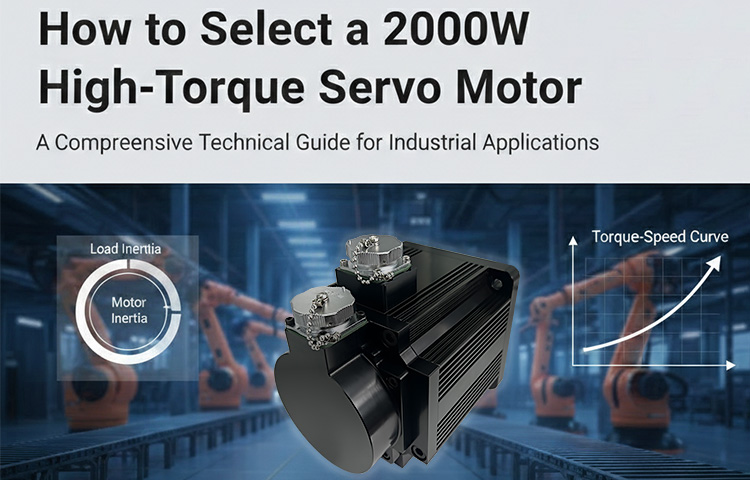
2.1 Torque-to-Inertia Ratio
This critical ratio determines how quickly a motor can accelerate and decelerate. For robotic applications, a high torque-to-inertia ratio is essential for:
- Rapid response to position commands
- Smooth acceleration and deceleration
- Minimized settling time
2.2 Feedback Resolution and Accuracy
Modern industrial robots require precise position feedback:
- Absolute encoders: Eliminate homing procedures after power loss
- High-resolution feedback: 17-bit or higher for precision applications
- Multi-turn absolute encoders: Essential for applications requiring unlimited rotation
3. Environmental Considerations
3.1 Protection Class Requirements
Industrial environments present various challenges:
- IP65 or higher: For environments with dust, oil, or water exposure
- High temperature resistance: For applications near heat sources
- Vibration resistance: Critical for mobile or high-speed robots
4. Integration with Robotic Control Systems
4.1 Communication Protocols
Ensure compatibility with your robotic controller:
- EtherCAT: High-speed, real-time communication
- CANopen: Robust and widely adopted
- PROFINET: Common in European automation systems
5. Case Study: ZGC Motors in Robotic Applications
5.1 Application: Automated Assembly Line
Challenge: A manufacturer needed to improve assembly precision while maintaining high cycle times.
Solution: Implemented ZGC130SV200 servo motors with absolute encoders.
Results:
- 30% improvement in positioning accuracy
- 15% reduction in cycle time
- Zero downtime due to motor-related issues in 6 months
6. Selection Checklist for Robotic Servo Motors
Before finalizing your selection, verify:
- ✅ Torque requirements match both continuous and peak demands
- ✅ Speed range covers all operational scenarios
- ✅ Feedback resolution meets precision requirements
- ✅ Protection class matches environmental conditions
- ✅ Communication protocol compatibility with existing systems
- ✅ Physical dimensions fit within robotic joint constraints
7. Future Trends in Robotic Motor Technology
7.1 Integrated Motor-Drives
The trend toward compact, integrated solutions continues to grow, offering:
- Reduced wiring complexity
- Improved thermal management
- Enhanced reliability through reduced connection points
Conclusion
Selecting the right servo motor for industrial robotics requires careful consideration of technical specifications, environmental factors, and integration requirements. By understanding your application’s specific needs and matching them with appropriate motor characteristics, you can ensure optimal performance, reliability, and longevity of your robotic systems.
Need assistance with your robotic motor selection? Contact ZGC Motors technical support for personalized guidance and customized solutions tailored to your specific application requirements.